

quarta-feira, 17 de junho de 2026

"Uns Oito ou Nove"

Como a fluidez dos números desafia a rigidez dos freios e contrapesos
Carta XCVII (97) De Usbek a Rhedi, em Veneza Tenho observado aqui nos franceses um costume mental que desafia toda a geometria e que faria empalidecer nossos matemáticos mais severos de Ispahan. Nesta terra, a exatidão é uma virtude que se celebra nos tratados, mas que se evita com extremo refinamento na vida prática. Outro dia, passava eu pelos aposentos de meu palácio quando meus olhos e ouvidos foram atraídos pela lucarna de uma dessas caixas luminosas a que chamam televisão. Ali, um homem público era submetido ao rigor de um interrogatório, uma espécie de tribunal cênico onde a verdade é exigida com gravidade, mas recebida com entretenimento. Indagado sobre a quantidade exata de certos eventos, o interpelado não hesitou em sacar um escudo retórico de uso universal entre eles: respondeu que eram "uns oito ou nove". Fiquei estático à porta, tomado por uma profunda reflexão sobre o espírito dessas palavras. Percebi que o numeral, para esses ocidentais, não é uma medida de peso, mas um estado de espírito.Aquele que diz "uns oito ou nove" pensa estar fixando um limite; na verdade, está inaugurando um abismo de incertezas. Sendo o "uns" o signo da imprecisão primitiva, o cálculo não se fecha em si mesmo, mas expande-se como os círculos na água. Analisando a mecânica desse pensamento, compreendi que "uns oito ou nove" carrega em seu ventre tanto a timidez de um "uns sete ou oito" quanto a audácia oculta de um "uns nove ou dez". O erro caminha para ambos os lados com igual direito de cidadania.Os europeus creem ter inventado a clareza com as luzes da filosofia, meu caro Rhedi, mas a verdade é que preferem viver na penumbra de suas estimativas flutuantes. Para eles, definir o mundo com exatidão seria o mesmo que aprisioná-lo, e eles amam demais a própria liberdade para se deixarem escravizar por um algarismo. De Paris, no 8º da lua de Saphar, 2026. Segunda Turma do STF - 16/6/2026 STF Transmissão ao vivo realizada há 8 horas Os ministros que integram a Segunda Turma do Supremo Tribunal Federal realizam, nesta terça-feira (16), a sessão de julgamentos. Acompanhe!
terça-feira, 16 de junho de 2026 A crise do Supremo, por André Mendonça, por Maria Cristina Fernandes Valor Econômico Levantamento do Insper mostra que o ministro é o de votos mais divergentes na Corte “Há um desequilíbrio entre os Poderes quando um tribunal avança pela criação de regras e não por sua aplicação”. Depois de uma exposição de 20 minutos sobre o impacto das decisões do Supremo Tribunal Federal na segurança jurídica do país, em evento fechado para CEOs, executivos e acadêmicos no Insper, o ministro André Mendonça sentou para uma sessão de cinco perguntas. Recorrendo ao conceito do “juiz criativo” do jurista italiano Luigi Ferrajoli, discípulo de Norberto Bobbio, emendou: “O Judiciário não pode dar a primeira e a última palavra, precisamos ter autocontenção”, tomando posição na contenda que mobiliza críticas da academia, da sociedade e do próprio colegiado, dividido entre o presidente da Corte, ministro Edson Fachin e o decano, ministro Gilmar Mendes, que joga em todas as posições. Apontou disfuncionalidade nas ações penais originárias iniciadas diretamente na Corte, como o inquérito das fake news, e criticou o elevado quórum de agentes legitimados a acessar o Supremo. “Tudo isso precisa ser discutido no processo constituinte derivado”, disse, numa referência explícita a uma reforma do judiciário. Ao elencar os princípios decisórios da boa prática jurídica, disse ser necessário evitar os abusos da retroatividade: “O STF aplica novas regras ao que já estava estabelecido. É algo que preocupa muito. Indicadores do Bird sobre regulação no Brasil são piores que os do Paraguai.” Se alguém ainda tinha dúvidas sobre a banda em que toca o ministro avesso a entrevistas e relator das duas das mais bombásticas ações em curso no STF, do Master e do INSS, conheceu ali seu diapasão. “O primeiro passo é reconhecermos que estamos doentes”, disse, ao atestar a “crise de credibilidade” das instituições. André Mendonça não entende por “autocontenção” a reclusão - “nosso gabinete não representa o mundo”. Exibiu sua vacina para o ativismo religioso ao citar a ida ao culto presbiteriano no último domingo onde disse ter abraçado uma idosa na cadeira de rodas e uma criança: “O julgador deve estar próximo do povo e da sociedade”. Contrariando orientação da Igreja Presbiteriana do Brasil, Mendonça compareceu no feriado de Corpus Christi, pela quinta vez, à Marcha para Jesus e, do trio elétrico, definiu o momento como “um marco histórico onde milhões de brasileiros se unem para testemunhar que foram transformados por Jesus”. O ministro não mencionou os inquéritos que conduz, mas sugeriu o rumo tomado: “Se os mecanismos de prevenção e responsabilização deixam de funcionar a sociedade chega à conclusão de que não vale a pena acreditar nas instituições e fazer o certo.” Preparou ainda aquela plateia para as citações que estavam por vir. O primeiro foi o alemão Jurgen Habermas - “Dizem que é de esquerda mas não me importo” - que tomou de empréstimo para descrever a “imparcialidade qualificada” com a qual o juiz deve estar aberto para ouvir as partes podendo até modificar sua pré-compreensão dos fatos. O segundo foi o indiano Amartya Sen: “Se estamos longe do ideal de justiça, comecemos por não cometer injustiças; nossas decisões devem prevalecer pela força dos argumentos e não pelo argumento da força.” E, finalmente, ao responder a uma pergunta do professor do Insper e coordenador do encontro, Diego Arguelhes, sobre a separação entre os Poderes, arrematou: “Nossas decisões impactam a sociedade e a política. Fui indicado por um presidente de direita, mas não estou lá para ser um ministro de direita, e, sim, julgar de acordo com a Constituição. E isso precisa ser percebido pela sociedade.” O ministro chegou depois que o ex-ministro Nelson Jobim já tinha falado e teve que deixar o auditório assim que terminou sua exposição para pegar seu vôo de volta para Brasília. Não viu, portanto, quando Jobim preparou o terreno com um histórico das disfuncionalidades que vulnerabilizam o STF. Nem tampouco quando professor do Insper, Ivar Hartmann, que, em grande parte, referendou as disfuncionalidades já decantadas com uma montanha de dados. Com dois colegas, Arguelhes e Evan Rosevear, minerou a base de dados do STF, com 2,23 milhões de votos de 1988 até 2023. Constatou que as decisões monocráticas são 94,8% do total - 6 mil por ano para cada ministro - sendo que 36% permanecem sigilosas. No inquérito das fake news, relatado pelo ministro Alexandre de Moraes, aquelas em segredo de justiça são a maioria. É Moraes também quem detém o recorde (43,8%) de processos distribuídos por “prevenção”, quando não há sorteio e o ministro que cuida de ação correlata fica com o processo. Foram constatadas 74% de decisões unânimes (nos EUA a parcela é inferior a 50%). O campeão de divergência foi o ministro Marco Aurélio Mello, que integrou a Corte durante 31 dos 35 anos da pesquisa e saiu em 2021. Sua taxa foi de 16,8%. Mendonça, que o substituiu, vem em seguida, com 2,4%. O levantamento abrange a estreia do ministro num tribunal em litígio com o governo Jair Bolsonaro e o primeiro ano do inquérito do golpismo. “O que a Corte decide depende, antes de tudo, de como ela decide. Em colegiado, um tribunal cujo dissenso é raro e ainda pouco estudado. Individualmente, um tribunal com prática cada vez mais distante daquela desenhada pela Constituição”, concluiu Hartmann num momento em que o ministro divergente já decolava para Brasília.
Foto: : Luiz Silveira/STF STF condena Eduardo Bolsonaro por coação no curso do processo sobre tentativa de golpe 1ª Turma seguiu o voto do relator da ação penal, ministro Alexandre de Moraes; em instantes, mais detalhes 16/06/2026 17:14 - Atualizado há 26 minutos atrás Post Views: 1.310 Fotografia da sessão da Primeira Turma em 16 de junho de 2026. Foto: : Luiz Silveira/STF Por unanimidade, a Primeira Turma do Supremo Tribunal Federal (STF) condenou, nesta terça-feira (16), o ex-deputado federal Eduardo Bolsonaro (PL-SP) pelo crime de coação no curso do processo. De acordo com o colegiado, ficou comprovado que ele atuou para interferir no julgamento da ação penal em que seu pai, o ex-presidente Jair Bolsonaro, foi condenado por tentativa de golpe de Estado. O ministro Cristiano Zanin, a ministra Cármen Lúcia e o presidente da Turma, ministro Flávio Dino, seguiram o voto do relator da Ação Penal (AP) 2782, ministro Alexandre de Moraes. Após o intervalo, a sessão será retomada para que o colegiado decida sobre a fixação da pena. Em instantes, mais detalhes. Leia mais: 15/6/2026 – STF julga nesta terça (16) ação contra Eduardo Bolsonaro por tentativa de interferência em julgamento sobre golpe de Estado Primeira Turma do STF - julgamento da AP 2782 - 16/6/2026 STF Transmissão ao vivo realizada há 3 horas Nenhuma descrição foi adicionada ao vídeo. Checks and balances Primeira Turma do STF - julgamento da AP 2782 - 16/6/2026 STF assistindo agora Transmissão iniciada há 3 horas Nenhuma descrição foi adicionada ao vídeo. STF Termo em inglês para 'freios e contrapesos'. Sistema de organização dos poderes do Estado (Executivo, Legislativo, Judiciário) no qual cada poder tem mecanismos para controlar e limitar os excessos dos outros, buscando o equilíbrio e evitando a tirania. Sinônimos Freios e contrapesos Aplicações práticas Direito Constitucional O princípio de checks and balances é fundamental no Direito Constitucional, pois assegura que nenhum dos poderes do Estado atue de maneira desmedida, garantindo a proteção de direitos e a estabilidade das instituições democráticas. Termos relacionados Freios e contrapesos Tião Carreiro e Pardinho * A Viola e o Violeiro jrjafilmes Texto Revisado" "Morre um homem, fica a fama e minha fama dá trabalho." QUEM PAGA ESCOLHE A MÚSICA QUE A BANDA TOCA. A Viola e o Violeiro: "Se alguém ainda tinha dúvidas sobre a banda em que toca o ministro avesso a entrevistas e relator das duas das mais bombásticas ações em curso no STF, do Master e do INSS, conheceu ali seu diapasão." "Tem gente que não gosta da classe de violeiro No braço desta viola defendo meus companheiros Pra destruir nossa classe tem que me matar primeiro Mesmo assim depois de morto ainda eu atrapalho Morre um homem, fica a fama e minha fama dá trabalho." Dono de banco, OK. Ex-banqueiro, vá lá. Colaborador premiado, ainda dá. Colaborador, jamais. Delator, perfeito. Delator premiado, suporta-se. New Balance, dizem que preciso colaborar. Com quem, cara pálida? Quem vai colaborar para a minha sobrevivência, após a colaboração que esperam de mim? Vejo muitos ex-colaboradores, premiados. Mais vale ser ex-colaborador, vivo e premiado, que premiado morto.
Versão ao Estilo de João Antônio Dono de banco? Tá legal, vá lá. Ex-banqueiro? Vá que seja, a gente engole. Delator premiado? É bicho que dá pra suportar, o sujeito entrega os caroços e salva a pele. Mas colaborador? Colaborador não dá, parceiro. Jamais. Colaborador é conversa mole, maquiagem de sala de estar. Cagueta é cagueta, dedo-duro puro e pronto. Delator, perfeito. O resto é gogó. Aí vem a estica, o calçado fino: New Balance. Dizem pra este aqui que o negócio é colaborar. É o marmelo. Mas vem cá, cara pálida. Colaborar com quem? Quem é que vai segurar o meu prato, garantir o meu almoço e a minha pele depois que eu botar a boca no trombone? Quem limpa a barra de quem se desgraça? O que eu mais vejo por aí é ex-parceiro premiado, jogado às traças, com o prêmio virando cinza no bolso. Jogo de piranha. Na lei da rua e no jogo da vida, a conta é curta e grossa, meu chapa: mais vale um cagueta vivo e esperto, respirando no sufoco, do que um premiado estendido no caixão, morto e engomado. 16/06/26 - Bananinha deve ser condenado. Um a menos na caterva extremista Marco Antonio Villa Transmissão ao vivo realizada há 9 horas #marcoantoniovilla #bananinha #eduardobolsonaro #marcoantoniovilla #bananinha #eduardobolsonaro
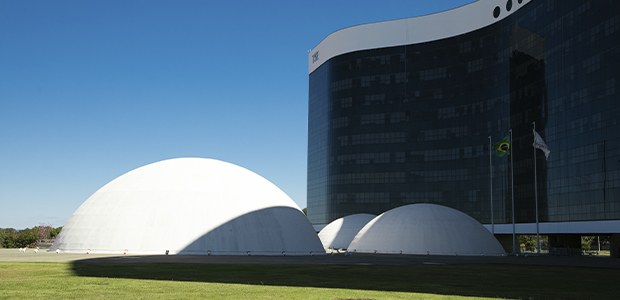
Leis e JustiçaBrasil O que é o STF e como difere de outros tribunais pelo mundo Edison Veiga 27/03/202327 de março de 2023 Herdeiro da corte trazida pelos portugueses à então colônia, Supremo Tribunal Federal é inspirado no modelo americano. Cargos vitalícios se justificariam pela atuação dos ministros sem pressões ligadas a um mandato.
Lucarne Camden Malthouse (left) and Camden Mill (1880) beyond, Bath[1] The term, "lucarne", is borrowed from French: lucarne, which refers to a dormer window, usually one set into the middle of a roof although it can also apply to a façade lucarne, where the gable of the lucarne is aligned with the face of the wall. This general meaning is preserved in British use, particularly for small windows into unoccupied attic or spire spaces.[2][3] Nikolaus Pevsner described it as "a small gabled opening in a roof or a spire".[4] The Encyclopædia Britannica says that, "A small dormer in a roof or a spire is called a lucarne".[5] Perguntas frequentes Última atualização: 12/05/2026 14:59:30 6584 pessoas já viram isso Transparência / Perguntas Frequentes O que é o Supremo Tribunal Federal? Quais as funções do STF? Quem compõe o STF? Como o STF se organiza? Como é o relacionamento entre o STF e os demais tribunais? Quantos funcionários os ministros podem ter em seus gabinetes? Quais são as principais competências do STF? Como se dá a tramitação de processos no STF? Como os processos são designados para os ministros? As decisões do STF são finais? Ou existem recursos para além do STF? Quais são algumas das principais decisões do STF? O que é o Plenário Virtual? Como funciona o Plenário Virtual (PV)? (duração, pedido de vista, destaque, fim do julgamento, possibilidade de revisão de voto, etc.) Todos os ministros apresentam votos escritos na sessão virtual? Como acompanhar as sessões do Plenário Virtual? Quando o julgamento é retomado no Plenário após o pedido de destaque, como ficam os votos já apresentados no julgamento virtual por ministros que se aposentaram? Como encontrar os votos dos ministros nos julgamentos do PV? E quando há pedido de destaque no julgamento do Plenário Virtual? Quando o julgamento é interrompido por pedido de destaque ou vista, como ficam os votos já apresentados no julgamento virtual por ministros que se aposentaram? Quais os tipos de ações são julgadas pelo STF? Como o STF define o que é julgado na Primeira ou na Segunda Turma? Casos criminais são julgados nas Turmas ou no Plenário? Como pesquisar/acompanhar o andamento de um processo em tramitação no STF? (pesquisa processual e push) Como acessar as pautas do Plenário do STF? (calendário no site, link “Ver temas”) Quando são divulgadas as pautas (ou por que não consigo acessar as pautas dos meses seguintes)? Como acessar as peças dos processos públicos em tramitação no STF? (link “Peças” nos processos objetivos, peticionamento eletrônico para processos subjetivos) É possível ter informações/acesso a peças em processos sigilosos/em segredo de justiça? Qual o prazo dos pedidos de vista no STF? Passado o prazo, o que acontece? Liminares concedidas “ad referendum” do Plenário (antes da decisão do colegiado) valem desde a decisão ou só depois do referendo? Os ministros têm prazo para analisar pedidos de liminar, agravos regimentais ou outras petições? Quais decisões individuais dos ministros são referendadas no Plenário? Decisões do STF contra uma determinada lei estadual derrubam automaticamente leis similares de outros estados? O que acontece quando o Congresso Nacional e o STF discutem o mesmo tema? Como conseguir informações sobre prazos processuais? (consultar códigos/leis ou especialistas) No geral, decisões finais em ADI passam a valer a partir de quando? Tem que aguardar julgamento de embargos? Qual o prazo para publicação dos acórdãos dos julgamentos? Os votos dos ministros ficam disponíveis antes da publicação do acórdão? Cabe recurso contra decisão individual (incluindo despacho) de ministro? Esse recurso é julgado pelo próprio ministro, pelo presidente ou pelo colegiado? O portal do STF possui algum canal que facilite o acesso e a compreensão de questões relevantes sobre os principais pontos de processos julgados pelo Supremo Tribunal Federal? Essa informação foi útil?

segunda-feira, 15 de junho de 2026

"Vamos falar mal de um outro cara."

Current time in Tehran12:06 a.m. June 16 Live Updated June 15, 2026, 4:26 p.m. ET9 minutes ago Iran War Live Updates: U.S. and Iran Sign Preliminary Deal, but Its Terms Remain Secret President Trump and Iran’s lead negotiator have signed an agreement that was expected to open the Strait of Hormuz. But the specific terms of the deal have not been released, and Israel’s leader appears not to be fully on board. Share full article Video "Hora atual em Teerã 12:06 a.m. 16 de junho Atualizado ao Vivo 15 de junho de 2026, 16:26 ET 9 minutos atrás Atualizações ao Vivo da Guerra do Irã: EUA e Irã Assinam Acordo Preliminar, mas Seus Termos Permanecem em Segredo O Presidente Trump e o principal negociador do Irã assinaram um acordo que era esperado para abrir o Estreito de Ormuz. Mas os termos específicos do acordo não foram divulgados, e o líder de Israel parece não estar totalmente de acordo. Compartilhar artigo completo Vídeo"
"Vamos falar mal de um outro cara" Bomba, bomba, bomba!!! Botafogo é campeão mundial disputado na Venezuela “Era Botafogo, Benfica — time principal, base da seleção principal de Portugal — e tinha o time de lá da Venezuela.” A FIFA ainda não reconheceu. “Pequena Taça do Mundo.” Manhattan Connection | 14/06/2026 Manhattan Connection
segunda-feira, 15 de junho de 2026 Um golpe à reputação dos EUA, por Oliver Stuenkel O Estado de S. Paulo O que está sobre a mesa não é um tratado de paz, mas o compromisso de continuar negociando Há mais de cem dias, a maior potência do mundo entrou em guerra contra o Irã para eliminar o programa nuclear iraniano, destruir suas capacidades militares e derrubar o regime. Nenhum desses objetivos foi atingido. Pelo contrário: não há sinais de que o Irã tenha interrompido seu programa nuclear; suas forças seguem atacando os vizinhos e o regime, antes fragilizado, passou por uma renovação e radicalização. Quem parece acuado não é Teerã, mas Washington. Ontem, em seu aniversário de 80 anos, Donald Trump anunciou que o acordo estava concluído, autorizou a reabertura do Estreito de Ormuz e o fim do bloqueio aos portos iranianos. O entendimento, mediado por Paquistão e Catar, prevê a assinatura na Suíça e estende por 60 dias o cessar-fogo. Mas o anúncio, mais do que encerrar a crise, expõe a posição em que os EUA se enfiaram: uma superpotência que ditou ultimatos, mas dependeu de mediadores para amarrar um texto cujos termos centrais ficaram adiados para uma negociação que apenas começa. Tudo isso é notável por dois motivos. Primeiro: os EUA haviam negociado um acordo nuclear com o Irã em 2015 (sob Obama), antes de Trump rasgá-lo em 2018. Segundo: a guerra impôs um custo. Como escreveu Robin Wright na revista The New Yorker: “A guerra custou US$ 28 bilhões, a vida de 13 americanos e de milhares de iranianos, o fechamento de Ormuz, a interrupção do fornecimento global de energia, uma crise econômica que atingiu centenas de milhões no mundo e um dano possivelmente irreversível à reputação dos EUA.” QUEDA. Além de perceber que está com influência limitada sobre Teerã, Trump enfrenta dificuldades de controlar Israel e Hezbollah, atores-chave no conflito. Ontem, um ataque israelense a Beirute quase descarrilou o acordo e obrigou Trump a declarar que o ataque “não deveria ter acontecido”. Que o entendimento tenha sobrevivido a esse episódio não apaga o fato de que TelAviv demonstrou, mais uma vez, poder de veto informal sobre qualquer diálogo entre EUA e Irã. Internamente, a guerra deu força aos radicais da Guarda Revolucionária, que não temem continuar ou até intensificar o conflito que os levou ao centro do poder. O que está sobre a mesa não é um tratado de paz, mas, segundo a revista The Economist, um compromisso de continuar negociando: a trègua estendida de 60 dias, a reabertura gradual do estreito, à medida que o Irã remove as minas, princípios gerais sobre o programa nuclear e um alívio de sanções condicionado e faseado, com os detalhes adiados. Foi Trump quem mais recuou. Por exemplo, a entrega do urânio enriquecido, antes inegociável, deu lugar à aceitação de que o Irã dilua o material e fique com ele. O resultado mais relevante, porém, não envolve o Irã, mas os aliados dos EUA no Golfo, que absorveram danos de uma guerra que não pediram e se deram conta de que ter uma base americana não os protegeu. Pelo contrário, tornou-os alvos do Irã. Ao perceber que os EUA não estavam dispostos a protegêlo, o Catar tentou negociar um acordo com o Irã, oferecendo suspender a produção de gás em troca do compromisso iraniano de não atacar suas principais instalações de energia. RISCO. Daí decorre a lição para empresas e investidores: o petróleo disparou com a destruição da oferta e depois recuou diante da expectativa de acordo, num vaivém que não foi episódio isolado, mas sintoma de um novo regime de risco – a volatilidade veio para ficar. Contratos futuros, seguros e reservas amortecem choques, mas não substituem o fluxo físico. Prêmios de seguro e fretes, enquanto isso, viraram custo permanente. Há, contudo, um beneficiário da instabilidade: ao tornar imprevisíveis os preços do petróleo, a guerra acelerou a corrida por energia limpa, e países castigados pela escassez passaram a enxergar painéis solares, baterias e veículos elétricos chineses como rota de fuga. Para Trump, sobra um caminho amargo: oferecer concessões para destravar um estreito cuja travessia, antes da guerra, ninguém precisava negociar, enquanto a questão nuclear fica para depois. Para o mundo, a herança é mais duradoura. Qualquer que seja o desenho final do cessar-fogo, o risco geopolítico elevado da energia virou um custo fixo. *Pesquisador do Carnegie Endowment, na Harvard Kennedy School, e professor de relações internacionais da FGV-SP WW ESPECIAL - QUAL A SITUAÇÃO ESTRATÉGICA DE ISRAEL NO ORIENTE MÉDIO? - 14/06/2026 CNN Brasil Transmissão ao vivo realizada há 13 horas WW — Programas na íntegra Assista ao WW Especial deste domingo, 14 de junho de 2026. #CNNBrasil Participam deste episódio Celso Lafer, ex-ministro das Relações Exteriores do Brasil, Danny Zahreddine, prof. de Relações Internacionais da PUC Minas, e Vinícius Rodrigues Vieira, prof. de Economia da FAAP de RI da FGV e do IDP. CANTO DAS TRÊS RAÇAS - CLARA NUNES claradobrasil
segunda-feira, 15 de junho de 2026 Gilberto Freyre e o ‘foot-ball mulato’, por Marcus André Melo* Folha de S. Paulo Para ele, nossos triunfos deviam-se a termos abandonado a restrição a negros que vigia também no Itamaraty O autor argumenta que o futebol criara as condições para, finalmente, o surgimento de heróis nacionais negros A Gilberto Freyre são atribuídos alguns mitos populares. Mas a tese de que a superioridade do futebol brasileiro se deve à miscigenação —ou, mais precisamente, ao "mulatismo"— não está entre eles. Provavelmente deveria estar. Em artigo intitulado "Foot-ball mulato", em sua grafia original, denotando as origens inglesas ainda muito presentes, Freyre escreveu: "Uma das condições dos nossos triunfos este ano me parecia a coragem que afinal tivéramos completa de mandar à Europa um team fortemente afro-brasileiro. Brancos alguns, é certo; mas grande número de pretilhões bem brasileiros e mulatos ainda mais brasileiros". O contexto era a Copa do Mundo de 1938, quando o país ficou em terceiro lugar e Leônidas foi eleito o melhor jogador. Era também o início da ditadura do Estado Novo que viria a persegui-lo e a confiscar sua correspondência. Freyre, que viria a ser consagrado como o pai do mito da democracia racial, faz dura crítica ao racismo do Estado brasileiro: "a escolha de jogadores brasileiros para os encontros internacionais andou por muito tempo obedecendo ao mesmo critério do Barão do Rio Branco quando senhor todo-poderoso do Itamaraty. Nada de pretos nem de mulatos chapados, só brancos ou então mulatos tão claros que parecessem brancos. Ou, quando muito, caboclos, deviam ser enviados ao estrangeiro mulatos do tipo do ilustre Domício da Gama, a quem Eça de Queiroz costumava chamar na intimidade de mulato cor-de-rosa". Na senda aberta por Freyre, Mário Filho produziu, quase dez anos depois, uma obra-prima, "O Negro no Futebol Brasileiro" (1947). No prefácio da obra, Freyre acrescenta um argumento novo: o futebol permitiu a sublimação —sim, ele foi pioneiro em mobilizar conceitos freudianos entre nós— de elementos irracionais e primitivos de nossa cultura, domesticando-os. E especula sobre o que teria acontecido com o samba, a capoeiragem e a malandragem. Seu vaticínio quanto ao cangaceirismo é profético, mas em sentido oposto ao que imaginou: "o cangaceirismo teria provavelmente evoluído para um gangsterismo urbano, com São Paulo degradada numa sub-Chicago de Al Capones ítalo-brasileiros". Mário Filho descreve a transformação ocorrida. O futebol não alterava a ordem das coisas. Pelo contrário. "Os ídolos do futebol, todos brancos. Quando muito, morenos. Preto só entrava no escrete uma vez na vida e outra na morte. E quando um branco que devia jogar estava fora, doente ou coisa que o valha. Então o preto podia jogar." E, mostrando que foi muito mais do que um cronista esportivo, arrematava: "O mulato e o preto eram, assim, aos olhos dos clubes finos, uma espécie de arma proibida. Não um revólver, uma navalha. Se nenhum grande clube puxasse a navalha, os outros podiam continuar lutando de florete". Freyre argumenta que o futebol criara as condições para, finalmente, o surgimento de heróis nacionais negros, como o dionisíaco Leônidas. Seu antípoda, Domingos, que jogava sem floreios, era "uma espécie de inglês desgarrado nos trópicos, como Machado de Assis" —mas, ainda assim, "tinha alguma coisa de concentradamente brasileiro", de "mulatismo". Freyre escreveu essas linhas em 1947, antes de surgirem Pelé e Garrincha. *Professor da Universidade Federal de Pernambuco e ex-professor visitante do MIT e da Universidade Yale (EUA) A SELEÇÃO DE 70 ERA IMBATÍVEL? GERSON EXPLICA POR QUÊ | BRABO PODCAST BraboTV 2 de abr. de 2026 🎬 CORTES BRABO PODCAST 🎙️ A Seleção Brasileira de 1970 é mesmo a maior de todos os tempos? 👀 Neste corte do Brabo Podcast / Braboteco, Gerson Canhotinha de Ouro manda a real sem filtro sobre aquela geração histórica — e solta uma frase pesada: 💣 “Se jogássemos 10 Copas, ganharíamos todas.” 🔥 Confiança ou realidade? Gerson explica por que acredita que aquela seleção era praticamente imbatível, destacando a qualidade técnica absurda, o entrosamento e o nível de jogadores que marcaram época no futebol mundial. ⚽ Neste vídeo você vai entender: ✔️ Por que a Seleção de 70 é considerada lendária ✔️ A visão de Gerson sobre o domínio daquela geração ✔️ O que tornava aquele time tão diferente Se você ama futebol raiz, história da Seleção Brasileira e debates sobre as maiores equipes de todos os tempos, esse corte é obrigatório! 🇧🇷🔥
ENTREVISTA! ENTREVISTA! — Gerson, vc tem assistido os jogos da Seleção? — Tentei… vi uns 10 minutos e desliguei… — Se a Seleção de 70 jogasse contra a atual, qual seria o placar? — Seria 1 a 0 pra nós ou 2 a 1… Por aí. O Pelé já morreu e nós estamos com mais de 80… Brasil 5 x 2 Suécia Final Da Copa 58 Rádio Bandeirantes FUTNÁTICO 13 de jun. de 2018 Narração - Pedro Luiz e Edson Leite Copa 1958 Final Brasil 5 x 2 Suécia 29/06/58 Gols - Liedholm, Vavá, Vavá, Pelé, Zagalo, Simonsson e Pelé. A GRANDE CORRIDA,VOLTANDO A 1958 Respirei fundo, olhei para a esquerda e disparei assim que ouvi o locutor — speaker! — dizer, na rádio da Leiteria Central, em frente ao Cine São Sebastião (o "Palácio Encantado da Noroeste"), em Lins: Pedro Luiz,¹⁰ Rádio Bandeirantes de São Paulo, Brasil, comandando a cadeia Verde Amarela Norte Sul do Brasil. No estádio de Rasunda, em Solna, Suécia, são 15 horas, horário do Brasil. Começa a decisão, final da Copa do Mundo de 1958. Gilmar; Djalma Santos, Bellini, Orlando e Newton Santos; Zito e Didi; Garrincha, Vavá, Pelé e Zagalo. Antes de seguir com a corrida cinema-minha casa, numa distância de aproximadamente um quilômetro, indo direto pela Luís Gama até a Paulo Giraldi, tomei fôlego. E corri. _____________________________________ Nota de rodapé:¹⁰. WhatsApp do Editor: Pedro Luiz Paoliello (São Tomás de Aquino, MG, 14 de junho de 1919 — São Paulo, 13 de julho de 1998), mais conhecido como Pedro Luiz, foi um locutor e comentarista esportivo brasileiro, considerado um dos maiores narradores da crônica esportiva do Brasil. Participou da cobertura de onze Copas do Mundo e dois Jogos Olímpicos. Rodapé:69 | eu vi um baile de debutantes ▲ Estava cansado de saber que o jogo começaria às três da tarde em ponto. Aconteceu que, na "vesperal das dez" do cinema daquele domingo, além do filme, tinha o capítulo final do seriado Látego, em dez episódios. Ninguém ia perder o mocinho que desarmava bandido com seu chicote de couro. Saiu todo mundo correndo para suas casas. Quando eu estava começando o segundo quarteirão, ali pela casa dos Cúcolo, ouço o rádio do Pedro Luiz. Quatro minutos decorridos no estádio de Rotunda, em Solna! Gunnar Gren passa à direita para Bergmark. Este, tramando, tenta descer pela direita; passa para Borjesson. (Estou pela casa do Bisteca, agora, casa do seu Júlio da Coletoria.) Este tenta mandar para o comando da ofensiva para Simonsson, este tenta a finta, finta e manda para Liedholm, que dribla e dispara para o gol. Golllll!!! (Eu já estava nos Ariano.) Gol da Suécia!!! Gol! (Casa do Jairo Borges, que se casaria com a Lilinha anos depois.) Merda! Intensifico a corrida. Entre a 13 de Maio e a Paulo Giraldi, cinco minutos depois, Pedro Luiz: Garrincha recebe de Didi que recebeu de Zito, agora fugindo pela direita; balança o corpo, ginga e manda para a área! Golllll!!! Gol do Brasil!!! Vavá!!! Vavá!!! Nove minutos de jogo. Gol do Brasil! Era o que eu tinha corrido. Nove minutos. Acelerei. Entrei correndo em casa. Todo mundo em volta do rádio mais ou menos potente. Rodapé:70 | PELO BURACO DA FECHADURA ▲ Garrincha monumental. Pelé para Zito, este para Garrincha, Garrincha faz a finta, centra e Vavá, na marra, o Peito de Aço. Gooooooooooooooooooooooooooolllllllll!!! Brasil vira, vira, vira... Agora são trinta e dois minutos da primeira etapa! Foguetes por toda a cidade, por todo o Brasil. O jogo terminaria cinco a dois. Os dois do Vavá, dois do Pelé e um do Zagalo (ainda com um "l" só), que a gente teria que engolir por décadas. Pulo abraçado com meu pai e meus irmãos menores. A Rua Paulo Giraldi, esquina com Luís Gama, é nossa! Alguém não resistiu ao trocadilho: "Em Rasunda, a Suécia levou na bunda!". Dois meses depois, na casa do Dondinho, pai do Pelé e amigo do meu pai, passarinheiro como ele, em Bauru, perto de Lins, abraçamos o Pelé. Ele tinha dezessete anos, eu doze. Cinco anos apenas de diferença. Todos tínhamos cara de moleque. E éramos. Leonel, meu irmão com sete anos, ficou tão nervoso e emocionado que fez cocô na calça. Dona Celeste trouxe um calção pra ele. Do Zoca, o caçula deles que tentou, mas não jogava nada.¹¹Nota de rodapé: ______________________ ¹¹. WhatsApp do Editor: Zoca hoje cuida dos negócios do Pelé nos Estados Unidos. WhatsApp do Editor II: Prata, lamento informar: Jair Arantes do Nascimento, o Zoca, o irmão que também queriam que fosse Pelé, morreu em Santos-SP, em 2020, com setenta e sete anos, após longa batalha contra um câncer. E agora, 2022, foi seu irmão Edson. Rodapé:71 | eu vi um baile de debutantes ▲
Current time in Tehran12:06 a.m. June 16 Live Updated June 15, 2026, 4:26 p.m. ET9 minutes ago Iran War Live Updates: U.S. and Iran Sign Preliminary Deal, but Its Terms Remain Secret President Trump and Iran’s lead negotiator have signed an agreement that was expected to open the Strait of Hormuz. But the specific terms of the deal have not been released, and Israel’s leader appears not to be fully on board. Share full article Video The United States and Iran reached a framework for peace on Sunday. Trump said the agreement would reopen the Strait of Hormuz after a monthslong blockade.CreditCredit...Arash Khamooshi/Polaris for The New York Times See more of our coverage in your search results. Add The New York Times on Google Latest Pinned Updated June 15, 2026, 4:04 p.m. ET32 minutes ago Zolan Kanno-YoungsErica L. GreenMax BearakJohnatan Reiss and Sanam Mahoozi Here’s the latest. The United States and Iran have signed a framework agreement ending their monthslong war, but neither side had published the deal’s full text, and on Monday American and Iranian officials continued to make conflicting statements about its terms. The agreement’s immediate scope was focused primarily on ending military attacks and allowing traffic to resume through the Strait of Hormuz, one of the world’s vital shipping lanes. American and Iranian officials acknowledged that they had put off discussions of their most serious disagreements until a later round of talks. The agreement did not appear to fulfill the objectives President Trump promised at the start of the conflict in February: destroying Iran’s military capabilities, abolishing its nuclear ambitions and toppling its theocratic leadership. Israel’s prime minister, Benjamin Netanyahu, who helped convince Mr. Trump to begin the war and ordered strikes on Iran alongside the United States, said on Monday his country’s “struggle has not ended.” Mr. Netanyahu cast the peace agreement as “Trump’s decision,” and vowed to preserve Israel’s “freedom of action” against emergent threats. That would include in Lebanon, where Iran and Pakistan have said Israel’s military operations must end as part of the agreement. News of the deal was still enough of a relief that oil prices tumbled, and Iranians expressed wary optimism that a war that has killed thousands could soon end. Mr. Trump said the deal would restart safe passage of oil tankers through the strait as soon as Friday, solving a problem that didn’t exist until the United States and Israel initiated the war. Returning the strait to its prewar conditions could relieve Americans of soaring gas prices, a political liability for the president, but experts say that will take months. Pakistan, which has been mediating talks between Washington and Tehran, said a ceremonial signing of the agreement would take place in Geneva on Friday. U.S. officials said Vice President JD Vance; Mr. Trump’s son-in-law, Jared Kushner; and the president’s special envoy, Steve Witkoff, would take part. After that, a 60-day period of negotiations toward a comprehensive peace agreement would begin. The talks are likely to be complex, and the deal could still come apart. Abbas Araghchi, Iran’s foreign minister, said on Monday that negotiations would grapple with two issues on which neither side has shown much willingness to compromise: easing American economic sanctions against Iran and limiting Tehran’s nuclear program. And they will be made more difficult, he said, by “a history of broken promises.” In an interview with CNBC, Mr. Vance acknowledged that the Trump administration still had “very important details to figure out” in the next phase of negotiations, including how it wants Iran to dispose of its stockpile of highly enriched uranium. It was also unclear what the deal would mean for Lebanon, where the Israeli military has been attacking Hezbollah, the Iran-backed militant group. Fighting in Lebanon appeared to ease on Monday but Mr. Netanyahu said Israeli troops would continue to occupy much of southern Lebanon, and U.S. officials said Israel’s withdrawal from Lebanon was not a condition of the agreement. Here’s what else we’re covering: Trump calls The Times: In a 28-minute phone conversation that he initiated from the White House, and a brief follow-up call, the president asserted that his decision to attack Iran and blockade its ports had remade the Middle East in America’s favor and saved Israel from nuclear obliteration. Read more › Europe meetings: Mr. Trump is in France to attend a summit of the Group of 7 nations, where the deal will be a major topic of discussion this week. Read more › Show more Shirin Hakim June 15, 2026, 2:56 p.m. ET2 hours ago Shirin Hakim Iran’s president, Masoud Pezeshkian, said on Monday that a draft memorandum with the United States was an important step, but stressed that no lasting pece agreement had been reached yet. In a series of posts on X, he said the text was the result of months of talks and had the backing of nearly all members of Iran’s powerful Supreme National Security Council. Still, he struck a cautious tone, saying Iran was prepared for all scenarios, a possible acknowledgment that talks could break down, and he described the memorandum as a test of whether the United States would respect Iran’s rights in practice. Johnatan Reiss June 15, 2026, 2:48 p.m. ET2 hours ago Johnatan ReissReporting from Tel Aviv, Israel Prime Minister Benjamin Netanyahu of Israel appeared to distance himself from the U.S.-Iran agreement, calling it “his decision,” referring to President Trump. Netanyahu said he had voiced his opinion in multiple conversations with Trump, but he did not say where they had disagreed. Johnatan Reiss June 15, 2026, 2:44 p.m. ET2 hours ago Johnatan ReissReporting from Tel Aviv, Israel In any agreement between Iran and the United States, Prime Minister Benjamin Netanyahu said, Israel would seek to “preserve its freedom of action” against emergent threats. He said Israel did so today, killing four people he said had posed a threat to Israeli soldiers in Lebanon. Asked whether the same principle would apply to Iran, he said he was committed to ensuring the country never posed a nuclear threat to Israel, but did not elaborate. Edward Wong June 15, 2026, 2:39 p.m. ET2 hours ago Edward WongEdward Wong reported from Beijing on President Trump’s visit there last month. He wrote a book on China after reporting there nearly a decade. He reported on the Iraq war before that. Trump thanks China and Russia, partners of Iran, for their diplomatic help. Image President Trump has referred to the leaders Xi Jinping of China, left, and Vladimir V. Putin of Russia as his friends.Credit...Kenny Holston/The New York Times, Doug Mills/The New York Times When President Trump gave thanks to those who had helped him reach an initial cease-fire agreement with Iran, he praised two world leaders he has called his friends — Xi Jinping of China and Vladimir V. Putin of Russia. The leaders, he said, had aided the Americans in sealing the deal with the Iranians, or at least had helped set the conditions by not sending oil and gas tankers or other commercial ships through the Strait of Hormuz to compromise a U.S. naval blockade aimed at pressuring Iran. “He was a total gentleman,” the American president said of Mr. Xi in an interview with The New York Times on Sunday, as he was celebrating his 80th birthday with a dinner and an Ultimate Fighting Championship cage match on the South Lawn of the White House. “He didn’t send a tanker, along with 20 destroyers on each side of it, to try and break up the blockade.” The White House did not reply to a request for comment on Monday on what Mr. Trump meant when he said Mr. Xi and Mr. Putin had helped the Americans and Iranians reach the initial agreement. The State Department referred questions to the White House. The Chinese and Russian embassies in Washington did not answer requests for comment. In recent months, Mr. Trump has embraced China as a partner. He had to retreat from a trade war with the country last year after retaliation by the Chinese government, and he subsequently praised Mr. Xi as a tough negotiator. He has also been trying to improve relations with Moscow, though Mr. Putin has resisted the American president’s efforts to get Russia and Ukraine to accept a settlement to end the full-scale Russian invasion that began in 2022. Mr. Trump and Mr. Putin spoke by phone on Sunday. Mr. Trump flew to Beijing last month for a summit and a state banquet hosted by Mr. Xi, the world’s most powerful autocrat. The two talked about trade, Taiwan and the war against Iran. Mr. Trump left gushing about Mr. Xi and said the two superpowers would form a “G2” partnership. “It’s the two great countries,” he told Fox News. China is Iran’s most powerful partner and the biggest buyer of oil from the country. China has worked in its own interests and acted with caution during the war. It has prodded Iran to continue negotiating with the United States, even when the mediated talks seemed to flag. At the same time, some Chinese companies have tried sending weapons to Iran, included shoulder-fired missiles, known as MANPADS, the U.S. State Department said. Last week, the State and Treasury Departments announced sanctions against Chinese-run or Chinese-linked companies that they said were trying to send weapons to Iran. The State Department list included Armory Alliance, which the agency said is a Belarus-based entity that has “acted as an intermediary between China-based companies and Iran.” The group, it said, “has been involved in facilitating the purchase of hundreds of man-portable air-defense systems (MANPADS) and their shipment from China to Iran, including attempting to route the shipments through third-party countries and obfuscating their origin and true end user.” Mr. Trump has not acknowledged those actions by Chinese companies. The moves do not amount to deep support by China for Iran during the war, in contrast to the way China has supported Russia in its yearslong invasion of Ukraine by providing critical supplies to Russian defense companies and weapons makers. Like China, Russia has been trying to position itself as a diplomatic back channel in the war. A partner of Iran, it has hosted Iranian diplomats in Moscow and spoken with American officials. It has also given Iran targeting information useful for attacks on American bases in the Middle East, U.S. officials said. As with China, Mr. Trump has made no mention recently of this or other anti-American actions on Russia’s part. China recently arrested an American citizen, U Min Zin, on the rare charge of spying, less than three weeks after Mr. Trump met with Mr. Xi in Beijing, The Times reported last Thursday. Around June 3, Mr. Min Zin, who studies Myanmar politics and foreign policy, disappeared in Kunming, the capital of Yunnan Province. American diplomats visited him in a detention center on Friday. Mr. Trump has not publicly spoken about the arrest. On Monday, Representative John Moolenaar, Republican of Michigan and the chairman of the House Select Committee on China, denounced the arrest. “China should immediately release Min Zin, an American citizen it has unjustly detained on absurd charges,” he said. “American companies should take note that this is how China treats innocent Americans and stop any work they are doing that supports China’s military and oppressive surveillance state.” Show more Johnatan Reiss June 15, 2026, 2:28 p.m. ET2 hours ago Johnatan ReissReporting from Tel Aviv, Israel Israeli reporters pressed Prime Minister Benjamin Netanyahu about his views on the framework agreement between the United States and Iran. He said that while he and President Trump often agreed, they had not always “seen eye to eye” as he pressed Israel’s interests. In a call early this month, Mr. Trump berated Mr. Netanyahu over their differences on Lebanon and Iran, and called the Israeli leader “crazy.” Johnatan Reiss June 15, 2026, 2:18 p.m. ET2 hours ago Johnatan ReissReporting from Tel Aviv, Israel In a news conference, Prime Minister Benjamin Netanyahu defended Israel’s wars with Iran, and said that they had managed to remove an immediate and existential threat posed by Iran’s nuclear ambitions. But, he said, Israel’s “struggle has not ended.” Image Credit...Pool photo by Ronen Zvulun Johnatan Reiss June 15, 2026, 2:17 p.m. ET2 hours ago Johnatan ReissReporting from Tel Aviv, Israel Prime Minister Benjamin Netanyahu of Israel said the Israeli military would remain in all of the areas he called “security zones,” including in Lebanon and Gaza, for “as long as it is required.” Iran and Pakistan contend that the U.S.-Iranian cease-fire agreement applies to Lebanon. Zolan Kanno-Youngs June 15, 2026, 1:08 p.m. ET3 hours ago Zolan Kanno-YoungsReporting from Geneva Vice President JD Vance, Trump’s special envoy Steve Witkoff and the president’s son-in-law Jared Kushner will lead the United States delegation at the official signing ceremony for the Iran deal on Friday in Geneva, according to U.S. officials. Vance will continue to lead negotiations in the next phase of the talks with Iran, according to a U.S. official. Zolan Kanno-Youngs June 15, 2026, 12:51 p.m. ET4 hours ago Zolan Kanno-YoungsReporting from Geneva U.S. officials are giving conflicting statements about when they expect the Strait of Hormuz to reopen completely, and when martime traffic will return to normal. While President Trump said the Strait of Hormuz would be completely open by Friday, another senior U.S. official told reporters that traffic will not return to normal for two weeks. Another U.S. official, in the same briefing call, said the strait would be completely open on Friday. Zolan Kanno-Youngs June 15, 2026, 12:34 p.m. ET4 hours ago Zolan Kanno-YoungsReporting from Geneva Israel’s withdrawal from Lebanon is not a condition of the U.S.’s peace agreement with Iran, according to the senior U.S. officials. But Iran and Pakistan, a mediator in the negotiations, said the agreement called for an immediate end to military operations on all fronts, including Lebanon. Zolan Kanno-Youngs June 15, 2026, 12:32 p.m. ET4 hours ago Zolan Kanno-YoungsReporting from Geneva President Trump and Vice President JD Vance both have electronically signed the framework agreement with Mohammad Bagher Ghalibaf, Iran’s lead negotiator, according to a senior U.S. official. Zolan Kanno-Youngs June 15, 2026, 12:29 p.m. ET4 hours ago Zolan Kanno-YoungsReporting from Geneva The Trump administration is prepared to release frozen funds if Iran reaches certain milestones in their agreement, according to U.S. officials who spoke to reporters about the new framework on the condition of anonymity. The officials added they were prepared to lift sanctions against Iran and will do “small gestures of that in the beginning” if Iran made good on the agreed upon commitments. Some $24 billion of Iranian funds are frozen abroad. Erica L. Green June 15, 2026, 12:18 p.m. ET4 hours ago Erica L. GreenReporting from Geneva Trump also claimed that the Strait of Hormuz was already “partially opened,” but added that “they’re hunting for a couple of mines.” Trump is expected to ask European leaders to help clear mines from the strait. He said although the United States doesn’t need help, it wouldn’t hurt to have “a ship or two up here from a few countries.” Video CreditCredit...Agency Pool, via AFP Erica L. Green June 15, 2026, 12:18 p.m. ET4 hours ago Erica L. GreenReporting from Geneva President Trump, speaking to reporters in Evian, France, ahead of his bilateral meeting with President Emmanuel Macron, lauded the framework of a potential peace deal that he signed with Iranian officials on Sunday. Trump said that he achieved his goal of preventing Iran from ever obtaining a nuclear weapon, saying “they fully agree to that, with strong policing powers.” The future of Iran’s nuclear program would be worked out over the next 60 days, however. The text of the memorandum has not been released but has been described in general by the president and members of his administration. Trump said the memorandum would be released but not until “sometime after Friday,” the public signing ceremony that he did not commit to attending. Vice President JD Vance will be there, Trump said. Video CreditCredit...Agency Pool, via AFP Sanam Mahoozi June 15, 2026, 11:52 a.m. ET5 hours ago Sanam Mahoozi Hanging over the next round of U.S.-Iran negotiations will be “a history of broken promises, non-compliance, and even the tearing up of agreements,” Abbas Araghchi, the Iranian foreign minister, said in comments reported by state media. “We are planning the negotiation process and the implementation of the agreement on the basis of mistrust, past breaches of commitments, and previous experiences.” Sanam Mahoozi June 15, 2026, 11:49 a.m. ET5 hours ago Sanam Mahoozi Iran’s foreign minister, Abbas Araghchi, offered a preview of a second stage of negotiations with the United States in comments to a meeting of government officials on Monday. “Issues related to the nuclear program and sanctions relief will be discussed, and may become the subject of a final agreement,” Araghchi told the officials, Iran’s state broadcaster reported. His comments confirmed that, under the announced deal for 60 days of cease-fire and negotiations on a lasting peace deal, the most intractable disputes between the United States and Iran have not been resolved. Image Credit...Elke Scholiers/Getty Images Ismaeel Naar June 15, 2026, 11:07 a.m. ET5 hours ago Ismaeel NaarReporting from Dubai, United Arab Emirates Oman’s foreign minister, Badr al-Busaidi, said that the agreement between the United States and Iran is a “timely win for diplomacy and common sense.” Oman has facilitated talks between the United States and Iran for years, including in the leadup to the latest war, but found itself in the cross hairs of the Trump administration and at odds with some of its Gulf neighbors during the war. Adam Rasgon June 15, 2026, 11:07 a.m. ET5 hours ago Adam RasgonReporting from Tel Aviv Gulf countries confront new questions about relying on U.S. protection. Image Three dark, silhouetted towers are positioned against a large orange sun. The foreground shows water with two small boats. The sun setting in Kuwait last week. Iran has attacked the oil-rich country and other U.S. allies in the Middle East during the war.Credit...Yasser Al-Zayyat/Agence France-Presse — Getty Images As Gulf countries breathe a sigh of relief that a preliminary deal between the United States and Iran will restore a degree of normalcy, they are confronting new questions about their decades-long reliance on the United States to ensure their security. The fear is particularly acute after that protective umbrella struggled to defend their cities and critical infrastructure during the conflict. “The U.S. security guarantee is no longer reliable in the way they thought it was,” said Sanam Vakil, the director of the Middle East and North Africa program at Chatham House, a London-based think tank. During almost four months of war, Iran and its allies struck military bases, energy facilities, and hotels in countries throughout the region and shut down the Strait of Hormuz, the strategic waterway for oil and gas shipments. The preliminary deal, Gulf leaders hope, will allow their countries to resume exporting oil and gas without Iranian interference, and permit their residents to return to daily life without fear of Iranian missile and drone attacks. Some Iranian drones were able to evade American defense systems, and the U.S. government and military appeared unprepared for Iran’s closure of the strait. Before the U.S.-Israeli war on Iran began in late February, there was a prevailing sentiment in the Gulf that the United States was looking increasingly inward and showing less interest in getting involved in conflicts in the Middle East. The feeling encouraged countries like the United Arab Emirates, Saudi Arabia and Kuwait to step up cooperation with other countries in Europe and Asia on security affairs. The war, Ms. Vakil said, most likely will accelerate the push to diversify. Two officials from Gulf states, who spoke on the condition of anonymity to discuss sensitive matters, said their governments have already held discussions on reducing their dependence on the United States. The officials, however, said their leaders were looking to increase cooperation with countries that the United States would consider acceptable. The United States has thousands of soldiers deployed at multiple bases in the Gulf, limiting the extent to which countries can turn in a different direction. Bader al-Saif, an assistant professor of history at Kuwait University, said he thought the Gulf countries needed to take more responsibility for their own security by building out their armies and developing defense technologies. “Across the Gulf, Iran is facing immense sanctions,” he said. “Yet, they’re able to develop their own national defense infrastructure. We should do the same. We have the finances and the know-how.” Gulf countries, Mr. al-Saif added, should also find ways to cooperate more effectively between themselves, overcoming internal competition and rivalry. For example, he said they should coordinate weapons procurement in a way that makes the most sense for the entire region. “We need to work in tandem,” he said. Show more Leo Sands and Sanam Mahoozi June 15, 2026, 10:57 a.m. ET6 hours ago Leo Sands and Sanam Mahoozi Turning to the wider region, Iran’s Foreign Ministry spokesman Esmail Baghaei reiterated Iran’s view that the agreement included a commitment to end the war in Lebanon between Israel and Hezbollah, without elaborating on what that would entail. He said Iran would hold the United States responsible for ensuring that Israel complied with that commitment, given that Israel is not a party to the agreement. “Failure to fulfill these commitments will naturally lead to a reciprocal response from Iran,” said Baghaei. Lara Jakes June 15, 2026, 10:50 a.m. ET6 hours ago Lara JakesLara Jakes has covered Mideast conflict and diplomacy for more than 15 years. Why the U.S.-Iran deal might work, and why it might not. Image The preliminary deal between Iran and the U.S. could still come apart.Credit...Arash Khamooshi/Polaris for The New York Times The framework to end the war in Iran pauses nearly four months of hostilities that have killed thousands of people and sent global energy prices soaring. Now comes the hard part. For all of the cautious optimism that the U.S.-Iran agreement could pave a path to peace, experts remained skeptical that it could survive the next 60-day round of negotiations on a final deal. The terms of the framework have not been released, and it’s possible, even likely, that negotiators on either side have interpreted the tentative agreement differently, analysts said Monday. Here’s a look at reasons the deal could survive, and why it might not. Why the deal might succeed Both sides want the Strait of Hormuz safely reopened to shipping traffic. The vital waterway for oil and gas has been shut down by Iranian attacks and by a U.S. naval blockade that sought to cut off Iranian oil revenue. If the strait reopens, it could calm global financial markets, help Iran’s economy and bring down soaring gas prices in the United States, possibly easing a political headache for President Trump. Both sides have burned through weapons. The Pentagon has moved military forces and vast numbers of air defense missiles to the Persian Gulf, where allied countries host American troops. That has potentially left other global hot spots vulnerable, particularly in Europe, where NATO is helping Ukraine defend itself against Russia, and in Taiwan and South Korea, which are worried about aggression from China. While U.S. intelligence assessments indicated as recently as a month ago that Iran retained much of its stockpiles of missiles and launchers, Tehran has launched more than 1,500 missiles and 4,700 drones against Gulf states since February, according to the Institute for National Security Studies in Tel Aviv. Mr. Trump is desperate to declare victory. The president has cast himself as a peacemaker, despite launching the war with Iran alongside Israel on Feb. 28. The war has sent his approval ratings to new lows and prompted some Republican lawmakers to break with him as midterm elections loom. James M. Dorsey, a Middle East expert at the S. Rajaratnam School of International Studies at Nanyang Technological University in Singapore, said the United States and Iran have gotten to “a point where both sides can declare victory.” Why the deal might fall apart Israel does not appear to be on board. After helping to push Mr. Trump to go to war in February, Israel was not directly involved in the U.S. negotiations with Iran. On Sunday, even as the framework appeared to be taking shape, Israel risked upending the talks with its continued strikes in Lebanon against Iran-allied Hezbollah. While Iran and Pakistan, a key mediator, asserted that the framework will end military operations on all fronts, including Lebanon, Israel’s defense minister on Monday indicated that his country’s attacks against Hezbollah would continue as long as Israel considered itself under threat. Sanctions and frozen assets may be a sticking point. Iran wants the United States to ease financial sanctions and unlock billions of dollars of its assets that are frozen in foreign banks. It is not clear how or if these issues are addressed in the framework, but Mr. Trump has repeatedly berated former President Barack Obama over a 2015 nuclear deal that gave Iran some respite on both fronts in exchange for curbs on its nuclear program. Mr. Trump withdrew from that deal in his first term. Iran may not agree to limits on its nuclear program. Mr. Trump has said he went to war in order to ensure Iran will never develop a nuclear weapon. Iran’s leaders have long insisted that their nuclear program is purely for civilian purposes, and that it has a right to enrich nuclear material under the Nuclear Nonproliferation Treaty. Negotiators will soon haggle over how long Iran should agree to pause uranium enrichment, at what levels it can enrich uranium in the future and what happens to the highly enriched uranium it already has — all deeply contentious issues. Nate Swanson, a former U.S. diplomat who is an Iran expert at the Atlantic Council, said that “there will likely be a significant delta” between what Iran and the Trump administration aspire to resolve and what is ultimately achieved in the talks. Show more Leo Sands and Sanam Mahoozi June 15, 2026, 10:10 a.m. ET6 hours ago Leo Sands and Sanam Mahoozi Iran’s Foreign Ministry spokesman Esmail Baghaei suggested that Iran had received commitments from the United States that it would eventually access frozen assets and secure the lifting of sanctions, but that the timeline was not clear. “Alongside nuclear-related matters, these are subjects that will be discussed immediately after the signing of the memorandum,” he told a news conference, according to state media, referring to the preliminary deal announced on Sunday. Leo Sands and Sanam Mahoozi June 15, 2026, 9:36 a.m. ET7 hours ago Leo Sands and Sanam Mahoozi In his first news briefing since the preliminary agreement was announced, Iran’s Foreign Ministry spokesman Esmail Baghaei offered a glimpse into the Iranian perspective on what was agreed. Referring to the Strait of Hormuz, Baghaei said that Iran would not seek to collect tolls on ships passing through the waterway, but suggested that Iran could still charge fees “in exchange for the services that are provided.” Trump had said the deal meant the strait would be “permanently toll-free.” Erica L. Green June 15, 2026, 9:33 a.m. ET7 hours ago Erica L. GreenReporting from Geneva President Trump said in a social media post Monday that ships were “starting to move” through the Strait of Hormuz. Trump’s post was curious, given that a small number of ships have been moving through the strait during the war, and Trump had said that the waterway would fully reopen after the deal is signed, which is scheduled to take place on Friday. Shipping companies said Monday that they were taking a cautious approach and needed more details before navigating through the waterway. Erica L. Green Zolan Kanno-Youngs June 15, 2026, 9:26 a.m. ET7 hours ago Erica L. Green and Zolan Kanno-YoungsReporting from Geneva news analysis Trump celebrates a win, but much remains unfinished. Image President Trump speaking seated in the Oval Office, with several people behind him. President Trump said on social media that the deal would “let the oil flow.”Credit...Eric Lee for The New York Times Almost immediately after striking a deal with Iran, President Trump appeared eager to take a victory lap. He trumpeted that the agreement would open the Strait of Hormuz, a vital waterway for the world’s energy supplies whose stalled ship traffic has rattled the global economy. He told The New York Times that his efforts had saved Israel from nuclear extinction and made the Middle East safer. It all gave him a key win as he traveled to France for the Group of 7 summit, where he will meet with European leaders who have criticized his approach to the war. Despite Mr. Trump’s grandiose claims, the agreement has not yet achieved the core goals he laid out three months ago for launching U.S.-Israeli war against Iran. Back then, Mr. Trump said the United States intended to “annihilate” Iran’s military capabilities, abolish its nuclear ambitions, topple its theocratic leadership and liberate its people, whom he encouraged to take over their government when the fighting had stopped. Just one week after the strikes started, he said Iran’s only path to a deal was an “unconditional surrender.” Mr. Trump publicly declared victory on Sunday mainly based on solving a problem of his own making, in miscalculating Iran’s ability to choke off the Strait of Hormuz. Mr. Trump asserted on Truth Social that he had authorized the toll-free opening of the crucial waterway, which would essentially restore the prewar status quo, and celebrated that the global energy markets would rebound. “Ships of the World, start your engines,” he wrote. “Let the oil flow!” Image A drone view from Oman of vessels static in the Strait of Hormuz beneath the light of a rising sun on Monday. Many vessels have remained in the Strait of Hormuz. Stalled ship traffic there has rattled the global economy.Credit...Reuters The latest framework, which has not yet been publicly released and is expected to be signed in Geneva on Friday, is a capstone to three months in which Mr. Trump has delivered a dizzying array of mixed messages. He said that Iran’s nuclear program had been “obliterated” in U.S. strikes last year, yet said that the war was necessary to stop the Iranians from obtaining a nuclear weapon. Mr. Trump said that Iran’s nuclear program posed a threat not only to allies, but also to U.S. troops overseas and to everyday Americans. He was clear that the war’s conclusion would rest on one stipulation: “It has always been the policy of the United States, in particular, my administration, that this terrorist regime can never have a nuclear weapon,” he said. “I’ll say it again. They can never have a nuclear weapon.” Even on Saturday, when he announced that a deal would be signed the next day, he claimed that Iran’s leaders “no longer want a nuclear weapon, nor will they have one, either through purchase, development, or any other form of procurement.” But the deal leaves that issue unresolved for at least another 60 days, when both sides are expected to negotiate on nuclear issues. Mr. Trump did not cast the deal as a solution to the nuclear threat. Instead he focused on the Middle East and his legacy. “This Great Deal will bring Peace and Security to the whole Region,” he wrote in a social media post. “Many presidents have tried to make Peace with Iran, and all have failed before me.” Mr. Trump has also sent conflicting messages over how far he would go to secure a nuclear agreement with Iran. He has gone from threatening to wipe out the country’s civilization to saying he was in no hurry to remove its remaining stockpiles of enriched uranium. At the start of the war, Mr. Trump initially claimed the United States would accomplish its goals in “four to five weeks.” He repeatedly compared the war in Iran to his quick military operation in Venezuela, in which the top leader was removed but much of the rest of the government remained in place, willing to work with the United States. This war instead dragged on for months, killing thousands of Iranian civilians and 13 American service members. Rather than bowing to the United States, Iran’s new leadership has been emboldened, consistently withstanding military and diplomatic pressure to persist in its goal of advancing a nuclear program. In negotiations with Mr. Trump’s son-in-law, Jared Kushner, and special envoy, Steve Witkoff, the Iranians have held firm on not giving up the right to enrich uranium. “As for the nuclear issues, there really is no agreement,” Daniel B. Shapiro, a former U.S. ambassador to Israel, said in a statement on X. “Iran knows how to drag out those negotiations, and try to pocket concessions along the way.” He added that the United States now appeared to be paying to reopen the Strait of Hormuz by potentially lifting sanctions imposed against Iran. The Trump administration has said Iran would receive no relief from sanctions or release of its frozen financial assets until it delivered on its commitments. The framework does provide a path toward potential peace and economic relief. And on Monday, both world leaders and global markets expressed optimism. Image People walking near a poster in Tehran that shows flag-waving figures in military garb and large images of ayatollahs. In a Tehran street last week. Rather than bowing to the United States, Iran’s new leadership has been emboldenedCredit...Arash Khamooshi/Polaris for The New York Times Chancellor Friedrich Merz of Germany, who previously said that the United States had “no strategy” and was being “humiliated” by Iran in the war, congratulated both sides on the diplomatic breakthrough, calling it a potential step toward “a reinvigorated global economy and a more secure Middle East.” But it was a cautious optimism given all the uncertainties. Crucially, Iran’s nuclear capability will need to be hashed out over the next two months of negotiations, raising questions over whether a lasting peace will materialize. Plenty of spoilers could arise along the way. Notably Israel, a partner in the war but not in the framework for peace, has been less than enthusiastic about the deal. Mr. Trump himself said in the Times interview that he was prepared to restart military attacks against Tehran if Iran failed to reach a final nuclear accord with the United States. Some of Mr. Trump’s allies appeared concerned over the unfinished aspects of the negotiations. Senator Lindsey Graham, Republican of South Carolina, who has long supported military action against Iran, said he was “somewhat concerned that Iran’s view of the agreement seems different than what the American negotiating team is claiming.” “I will be watching closely the ensuing negotiations regarding Iran’s nuclear program and other matters,” Mr. Graham said. He added that Vice President JD Vance, whom he described as the “architect of the deal,” should ensure that the final deal is presented to Congress. In an interview with CNBC on Monday, Mr. Vance said the framework gave the administration “leverage,” though there remained “details to figure out,” including on enriched uranium. As negotiations progressed over the weekend, Mr. Trump posted a lengthy criticism on social media of the previous deal struck with Iran by President Barack Obama, asserting that the one he was working on would be better. Mr. Shapiro, who is also a fellow at the research institute The Atlantic Council, said on social media that Mr. Trump seemed focused on comparing his deal favorably to the Obama deal, but the United States was far from being able to come to such a conclusion. “It is possible that no deal will ever be reached,” Mr. Shapiro said, “and very likely that if one is reached, it will be worse than what we could have achieved through diplomacy before the war.” Show more Leo Sands and Reham Mourshed June 15, 2026, 9:11 a.m. ET7 hours ago Leo Sands and Reham Mourshed In its statement, Hezbollah characterized the U.S.-Iran preliminary agreement as a “prelude” to its wider ambition of securing the withdrawal of Israeli forces from Lebanon. Hezbollah also urged displaced Lebanese residents to wait before returning to their homes in the south, citing “risks arising from possible Israeli violations” of the cease-fire. David M. Halbfinger Ronen Bergman June 15, 2026, 9:11 a.m. ET7 hours ago David M. Halbfinger and Ronen Bergman news analysis Israel counts the ways that Netanyahu’s Iran strategy failed. Image Prime Minister Benjamin Netanyahu of Israel, dressed in a dark suit and bright blue tie, speaks into a microphone. Prime Minister Benjamin Netanyahu of Israel speaking in Jerusalem in April.Credit...Pool photo by Ilia Yefimovich For Prime Minister Benjamin Netanyahu of Israel, the war he had hoped would secure his legacy — Israel and the United States together attacking Iran — may be ending in a way that could sully it. The framework agreement to end the war, announced on Sunday, omits some of the most important things Israel wanted. The full text of the deal has not yet been released, and Israel was not directly involved in the negotiations. But initial details suggest that it does nothing to curb Iran’s ballistic missile arsenal, or its funding of regional proxies like Hezbollah in Lebanon and the Houthis in Yemen, who have attacked Israel with their own arsenals. It could help Iran bolster those proxies by easing sanctions, which would allow billions of dollars to flow into its bank accounts. When it comes to constraining Iran’s nuclear program — a matter of greatest importance to Israel and the greatest priority of Mr. Netanyahu’s career — the terms of the deal remain undisclosed or still to be negotiated during the agreed 60-day cease-fire. Questions remain over what will become of Iran’s stock of highly enriched uranium and whether the country will be able to keep enriching nuclear fuel. And while Israeli officials disputed this, Iranian officials said on Sunday that the framework included a halt to “military operations on all fronts, including Lebanon, effective immediately.” That could constrain Israel’s battle against Hezbollah. In a news conference Monday night, Mr. Netanyahu said that Israel would seek to “preserve its freedom of action” to act against threats, including in Lebanon. He said Israel had done just that earlier in the day, killing four people he said had posed a threat to Israeli soldiers. Asked whether the same principle would apply to Iran, he said he was committed to ensuring the country never posed a nuclear threat to Israel, but did not elaborate. Mr. Netanyahu alluded only obliquely to any differences of opinion with Mr. Trump over the agreement, saying that while he and the president “often see eye to eye,” there were also “cases where we see less eye to eye.” Others in his government were more blunt. “The agreement with Iran is bad for Israel and the entire free world. Period,” Bezalel Smotrich, the far-right finance minister, wrote on social media earlier on Monday. Worse still for Mr. Netanyahu, who faces re-election in a few months and is behind in the polls, President Trump, the Israeli leader’s most valuable political asset, has publicly rebuked him multiple times in recent weeks. While Mr. Trump has praised Iran’s new supreme leader, Mojtaba Khamenei, as pragmatic, he has called Mr. Netanyahu “crazy,” ungrateful and lacking in judgment. “The strategic mistake that Netanyahu made was failing to understand that just as Trump is with you, he could also flip on you,” said Yaakov Katz, an analyst and co-founder of the Middle East-America Dialogue. On Sunday, Mr. Trump added “difficult” to that litany of insults hurled at Mr. Netanyahu. That came after Israel’s military — precisely as the United States was trying to close its deal with Iran — struck what it described as a Hezbollah target on the outskirts of Beirut, the Lebanese capital, in retaliation for a Hezbollah attack that wounded two Israeli soldiers. In effect, Mr. Netanyahu appeared to have fallen into a trap. Had he refrained from hitting back at Hezbollah at that moment, his growing number of critics, including on the Israeli right, surely would have accused him of allowing a new “equation” to take hold. Striking Beirut could have been seen as off-limits to Israel because of Iran’s alliance with Hezbollah and Mr. Trump’s determination to close a deal with Tehran. Image Rescue workers face a bombed out building, debris and mangled machinery. Rescue workers at the site of an Israeli airstrike on the southern outskirts of Beirut, Lebanon, on Sunday.Credit...Daniel Berehulak/The New York Times But going ahead with the strike was equally perilous for Mr. Netanyahu. Two Israeli defense officials said senior military commanders raised concerns that a strike would prompt Iran to fire missiles at Israel in retaliation, setting off a new escalation of violence. Israel would then be accused of trying to derail the U.S.-Iran agreement just as it was being clinched, they feared. The strike put Mr. Netanyahu at odds with Mr. Trump for the third straight week over Israel’s freedom to retaliate in Lebanon for Hezbollah attacks. Notably, Israel did not consult or coordinate the strike with the United States; it only notified the U.S. military moments before it began, according to the two officials, who insisted on anonymity to discuss sensitive security matters. If Mr. Netanyahu’s goal indeed was to blow up the pending U.S.-Iran deal, he failed to anticipate how forcefully Mr. Trump would push to save it. Three hours after Israel picked up information that Iran was preparing to attack it with missiles sometime on Sunday night, the two defense officials said, Israel learned that Iran had halted those preparations to give Mr. Trump a chance to calm the situation and close the agreement. Israel now finds itself counting the ways that Mr. Netanyahu’s grand strategy against Iran has failed. And Israelis are increasingly convinced that it will make the 2015 Iran nuclear deal look “perfect in comparison,” as the Netanyahu biographer Ben Caspit wrote in the Israeli daily Maariv on Monday. For more than a decade, Mr. Netanyahu has steadily raised his bets in pursuing his strategy against Iran. His 2015 address to Congress denouncing then-President Obama’s nuclear agreement with Iran broke with decades of Israeli bipartisanship and left Mr. Netanyahu frozen out of the talks. His alliance with President Trump alienated Democrats, a growing number of whom turned against Israel during its war with Hamas in Gaza. The war with Iran, and the perception that Israel had dragged the United States into it, added many Republicans to that column. With its lofty goal of toppling the Iranian regime, the war was the culmination of Mr. Netanyahu’s long-term strategy. But it ended up showing Iran that the thing it feared most — the might of the U.S. military — was something that it could withstand, said Shira Efron, an analyst at RAND Corporation, a think tank. “Israel has lost all its leverage, and this has real costs,” she said. “The U.S. can just sort of walk away. But Israel is here in the region with an Iran that is only more threatening.” Mr. Katz, the analyst and a former editor of The Jerusalem Post, said the upshot of the U.S.-Iran agreement was a return to Israel’s strategic position in the region before the Hamas-led Oct. 7, 2023 attack on Israel that started the war in Gaza. “If there is intelligence one day in the future that Iran is building a nuclear weapon and enriching the military-grade uranium, Israel will have to go it alone,” he said. “We can’t rely on anyone else now.” Mr. Katz said that Israel’s three main current adversaries — Hamas in Gaza, Hezbollah in Lebanon, and Iran — could persuasively argue that they had prevailed in their conflicts with Israel. “Because victory for them was always about survival,” he said. “Because all three of them still have military capabilities. And because of the legitimacy granted to them.” Mr. Netanyahu’s difficulty managing his relationship with Mr. Trump could be glimpsed in his failure to come out and say publicly what some members of his own right-wing coalition were already saying on Monday — that the U.S.-Iran deal was terrible for Israel. In his news conference Monday night, the Israeli leader made only the slightest nod to the shortcomings of the agreement. He defended Israel’s wars with Iran, and said that they had “saved the State of Israel from annihilation.” But, he added, Israel’s “struggle has not ended.” Johnatan Reiss contributed reporting from Tel Aviv. Show more Christina Goldbaum June 15, 2026, 9:11 a.m. ET7 hours ago Christina GoldbaumReporting from Beirut, Lebanon The new agreement leaves Lebanon’s fate murky. Video Displaced Lebanese Families Warned Not to Return Home 1:46 Lebanese families displaced by fighting between Israel and Hezbollah were warned not to return home despite the U.S.-Iran framework agreement.CreditCredit...Daniel Berehulak/The New York Times The United States and Iran have struck an initial agreement to end their war. But, once again, Lebanon’s fate is far from clear. Iranian and Pakistani officials said that the agreement included an end to the fighting in Lebanon. But neither the United States nor Iran have released the contents of the agreement itself. And President Trump has not publicly commented on whether the cease-fire extends to the fighting between Israel and Hezbollah, the Iran-backed armed group, there. In recent months, Israel, which was not directly involved in the U.S.-Iran talks, has repeatedly signaled that it does not feel bound by such agreements. It has continued to bombard Lebanon, despite the announcement of several cease-fires in recent weeks. On Monday, Israel’s defense minister, Israel Katz, said that the country’s forces would remain in the swath of Lebanese territory that they have occupied since the start of the war. He added that the area would be “cleared of local residents” and that the Israeli military would continue to demolish houses in the area. The previous day, the Israeli military struck the suburbs of the Lebanese capital, Beirut, threatening to scuttle the U.S.-Iran agreement at the last minute. The uncertainty in Lebanon reflects the country’s precarious place in the wider conflict and the waning credibility of recent cease-fire agreements there. For weeks, the country has been a flashpoint in the negotiations between the United States and Iran over a framework for peace. Iran has insisted that any agreement with the U.S. extend to the conflict in Lebanon. The war there erupted after Hezbollah, the Iran-backed Lebanese militia, fired at Israel in solidarity with Tehran days after the U.S.-Israeli war on Iran began in late February. But Prime Minister Benjamin Netanyahu of Israel has been intent on continuing his military offensive against Hezbollah in Lebanon and has sought to disentangle the two conflicts. He may lose that battle, depending on the extent to which both Iran and the United States expect Israel to wind down its military campaign. Despite the announcement of the agreement, Israeli forces were still shelling Hezbollah targets and carrying out controlled demolitions in southern Lebanon on Monday, although witnesses said the strikes were less intense than earlier in the war. Israeli surveillance drones were buzzing over the Lebanese capital, Beirut. And Lebanese officials and Hezbollah warned families displaced from the south not to return to their homes just yet. Hassan Rahal, who was displaced from his home in the southern town of Burj Rahal, heeded that warning. “Things aren’t stable yet,” he said from Beirut, where he rented an apartment when the war started. “I don’t know yet if this is a real cease-fire,” he added. Others were determined to go home, despite the risks. Hussein Jaber, 41, said he witnessed an Israeli artillery strike in the morning as he returned to his village of Mayfadoun, in the southern district of Nabatieh. But even before the strike, he was convinced that he would not be able to return home for good anytime soon. “I was really shocked to see the scale of damage in the town,” he said. “Houses are leveled, mine was destroyed too. I can’t bring my family back here.” Hwaida Saad contributed reporting. Show more Leo Sands and Reham Mourshed June 15, 2026, 9:09 a.m. ET7 hours ago Leo Sands and Reham Mourshed Hezbollah issued a statement on Monday congratulating Iran, its primary backer, for what it described as the “major achievement” of securing a “comprehensive ceasefire on all fronts, including Lebanon.” The statement expressed “deep gratitude” for Iran’s “unwavering support for Lebanon, its people, and its resistance, and for their insistence that Lebanon be included in any understanding leading to an end to the war and the safeguarding of its rights.” Zolan Kanno-Youngs June 15, 2026, 8:57 a.m. ET8 hours ago Zolan Kanno-YoungsReporting from Geneva Vice President JD Vance also acknowledged that the Trump administration still had “very important details to figure out” in the next phase of negotiations, including how to destroy or dispose of Iran’s stockpile of highly enriched uranium. Image Credit...Doug Mills/The New York Times Zolan Kanno-Youngs June 15, 2026, 8:56 a.m. ET8 hours ago Zolan Kanno-YoungsReporting from Geneva In an interview with CNBC, Vice President JD Vance described the agreement with Iran as a major step towards peace, but did not divulge specific details of the deal. “We have the diplomatic, economic, and military leverage, but we also are extending an open hand to the Iranians, and saying, if you guys negotiate in good faith and you make that long-term commitment not to develop nuclear weapons, then we are going to make sure that your country is successful,” Vance said. This preliminary agreement, however, does not achieve the core goals he laid out three months ago for launching the U.S.-Israeli war against Iran, including abolishing its nuclear capabilities. Leo Sands and Hwaida Saad June 15, 2026, 7:52 a.m. ETJune 15, 2026 Leo Sands and Hwaida Saad Israel and Hezbollah, the Iran-backed militia, appeared to scale back their fighting in southern Lebanon on Monday, after the United States and Iran agreed to a new cease-fire deal. People in the area said Israel had continued to launch strikes but the scale seemed to be less intense. Hussein Jaber, 41, said he saw an Israeli artillery strike in the morning as he returned to his home in the village of Mayfadoun. At a nearby hospital, the head of the government’s civil defense emergency service in the area, Khodor Ghandour, shared photographs that he took showing plumes of smoke rising above buildings. The Israeli military declined to comment in response to a request for information about the reported strikes. Speaking on condition of anonymity over fear for their safety, a Hezbollah official on Monday urged displaced residents of southern Lebanon to delay any return home until it was clearer that the fighting was over. Image Credit...Reuters Jenny Gross Peter Eavis June 15, 2026, 7:49 a.m. ETJune 15, 2026 Jenny Gross and Peter EavisJenny Gross, based in London, and Peter Eavis, in New York, have been writing about the shipping disruptions in the gulf since the war began. Shipping firms are cautious as they await details of the deal. Image Dozens of small boats float on dark, calm water, some leaving faint trails. A hazy sky transitions from light orange to gray. Vessels in the Strait of Hormuz, as seen from Musandam, Oman, on Monday.Credit...Reuters The preliminary deal to end the war between the United States and Iran seeks to quickly reopen the Strait of Hormuz, but companies said on Monday that they need more details before navigating the waterway. Since late February, when the United States and Israel attacked Iran, the strait has been effectively closed, leaving hundreds of ships stranded in the Persian Gulf, unable to transport oil and gas to global markets. “There are a lot of questions that need to be clarified,” said S.V. Anchan, the chairman of Safesea Group, a shipping company based in Piscataway, N.J., that has two ships in the gulf, both of which had been attacked since the war’s start. One of the ships was so badly damaged that it was not operating and the other was waiting to leave the gulf. Mr. Anchan said he wanted a clear commitment from Iran that ships could pass through the strait safely. “We want to hear from the Iranians that they will not attack us,” he said. How many ships cross the Strait of Hormuz a day Note: Data may not include all activity because some vessels have turned off tracking capabilities during the war.Source: Lloyd’s List.The New York Times The United States and Iran were expected to sign the agreement on Friday in Geneva. Critical issues that have divided the countries, including the fate of Iran’s nuclear program, have been deferred to later negotiations. The text of the agreement, which Iranian officials described as a memorandum of understanding, has not been released. “Let’s hope this time it’s for real,” said Harry Vafias, the chief executive of Stealth Gas, which has had three vessels stuck in the Persian Gulf for more than three months. He said he hoped he would get certainty after the signing of the agreement on Friday, but added, “I don’t give it a big possibility.” President Trump said on Sunday that the agreement with Iran would ultimately ensure that the Strait of Hormuz was “permanently toll-free.” As of Monday, Iranian officials had not commented on the specifics of the agreement. The president said the strait was partially open Monday and that mines needed to be cleared. He added that the strait would be completely open by Friday. In retaliation for the U.S.-Israeli strikes, Iran has attacked vessels to deter ships from passing through the strait without its permission. This campaign pushed up oil prices and gave Iran valuable leverage against the United States. Some ships were able to get out of the gulf through the strait. They did so with Iranian permission or with assistance from the U.S. military. Kpler, a ship tracking company, said about 500 large commercial vessels remained in the gulf. The Japanese Shipowners’ Association said that it would wait for “more concrete information.” There are 38 Japanese-related vessels stranded in the gulf, the association said. Another shipping executive, Andreas Enger, chief executive of the Norwegian shipping company Höegh Autoliners, said that news of the agreement alone was not enough to allow for the immediate resumption of ships through the strait. “But let’s hope that it is the start of the process that will get us there,” he said. Mr. Enger said it could take weeks or even months for him to feel comfortable sending ships into the Persian Gulf. “There very well may still be uncertainties and unresolved issues that would drag this out even longer,” he said. His company had one stranded ship that was able to leave the gulf with heavy naval and air protection from the U.S. Navy. Arsenio Dominguez, the head of the International Maritime Organization, said on Monday that the agreement was “an important step toward restoring safety in this vital maritime corridor for seafarers and ships.” But he added that it would take time to ensure that security guarantees were put in place to evacuate the roughly 11,000 stranded seafarers. There are also significant logistical steps that need to be taken for ships to begin to safely pass through the strait. Shipping companies would want a neutral body, like the International Maritime Organization, to identify safe routes and a sequence for ships to exit, said Jakob P. Larsen, the chief security officer at Bimco, the world’s largest shipping association. “If they all go in one big pile, there’s a really big risk of navigational incidents, collisions, things like that,” he said. Pankaj Khanna, the chief executive of Heidmar Maritime Holdings, which has one ship stranded in the Persian Gulf, said he hoped the agreement would provide a framework for how ships could safely transit the strait, including what route to take to avoid possible mines. Some ships that have exited the gulf have run close to the Iranian coast, most likely with permission from Iran, while others have traveled close to Oman, in coordination with the U.S. military. “Do we hug the Iranian coast or the Omani coastline?” Mr. Khanna said. In recent weeks, a small number of ships have entered the Persian Gulf. A test of any final agreement would be the willingness of companies to resume traffic into the gulf in large numbers. “We would need clear assurances from both sides that the strait is fully open and safe,” Mr. Larsen said. “It’s not enough that transits are permitted. They also need to be safe.” Hisako Ueno contributed reporting from Tokyo. Show more Ismaeel Naar June 15, 2026, 7:13 a.m. ETJune 15, 2026 Ismaeel NaarReporting from Dubai, United Arab Emirates The United Arab Emirates welcomed the agreement between the United States and Iran, saying it affirmed the importance of diplomacy and international law as it called for an end to all hostilities “in a manner that enhances security and stability in the region.” The Emirates hosts several large American military bases and was targeted by Iranian retaliatory attacks during the conflict. It had adopted a more aggressive posture toward attacking Iran in response than its neighbors during the war. Elian Peltier June 15, 2026, 6:53 a.m. ETJune 15, 2026 Elian PeltierReporting from Islamabad, Pakistan Prime Minister Shehbaz Sharif of Pakistan said in a speech in Parliament on Monday that his country would host the signing ceremony of the U.S.-Iran agreement scheduled for Friday in Geneva, after interceding for months between American and Iranian officials. Top officials from both countries held their first round of talks in Islamabad in April and Pakistan’s army chief, Field Marshal Syed Asim Munir, has been a key a go-between for President Trump and Iranian leaders. A spokesman for Mr. Sharif did not immediately respond to a request for clarification on what it would mean for Pakistan to host the signing ceremony in Geneva. Leo Sands June 15, 2026, 6:51 a.m. ETJune 15, 2026 Leo Sands Here’s what to know about the U.S.-Iran framework. Image Two people walk past a mural. Women in Tehran passing a mural showing Iranian missiles attacking an American ship.Credit...Arash Khamooshi/Polaris for The New York Times The United States and Iran have reached a preliminary agreement to cease hostilities for 60 days and reopen the Strait of Hormuz, paving the way to future talks that could ultimately end their monthslong war. The full text of the agreement has not been published. But emerging details suggested that some of the most difficult issues, including the fate of Iran’s nuclear program, have been deferred to future rounds of negotiations. The framework commits the United States to begin dismantling its naval blockade of Iran, while Iran will clear mines in the Strait of Hormuz and reopen the vital waterway to shipping, according to officials briefed on the document. In effect, that would return the situation to the status quo in late February, when the war began. Here’s what to know. Who announced the agreement? The United States and Iran, alongside Pakistan, which has been playing the role of mediator, all said on Sunday that an agreement had been reached, although they used varying language to describe it. President Trump said in a post on social media that “This Great Deal will bring Peace and Security to the whole Region.” Iran’s Supreme National Security Council described the agreement as a “memorandum of understanding.” Prime Minister Shehbaz Sharif of Pakistan said that the United States and Iran had committed to an “immediate and permanent termination of military operations on all fronts, including in Lebanon,” a point that was also emphasized by Iranian officials. Fighting erupted in Lebanon between Israel and Hezbollah, the Iran-backed militia, soon after the U.S.-Israeli war on Iran began in late February, and has been a key sticking point in the U.S.-Iran talks. Neither Israel nor Hezbollah, the warring sides in Lebanon, is a party to the agreement between the United States and Iran. It is unclear how the new deal will affect the fighting there, although Israeli officials on Monday rejected the prospect of any military withdrawal from Lebanon. What is the timeline? The United States and Iran have agreed to a multistage framework involving lengthier negotiations. Iran’s deputy foreign minister, Kazem Gharibabadi, told state television that Iran’s commitments under the agreement — which he did not detail in full — would begin on Friday, when the deal is scheduled to be formally signed in Geneva. After that, the United States and Iran will cease hostilities for at least 60 days to allow for negotiations to resolve outstanding issues. Mr. Sharif said that mediators will “lay the foundations for the technical talks” in a series of discussions this week. Mr. Gharibabadi said that Iran’s nuclear program — a critical, unresolved issue — will be among the issues to be discussed in the next round of negotiations. What about the Strait of Hormuz? Before the war, around one-fifth of the world’s oil supply transited through the Strait of Hormuz, which was in effect shut down by Iran during the fighting, leading to a spike in global energy prices. Mr. Trump said on social media Sunday that the strait would reopen to commercial shipping on Friday, suggesting that Iran would first remove mines from the crucial waterway. He also said that he had ordered an immediate end to the U.S. naval blockade of Iranian ports, which began in mid-April in an effort to block the flow of Iranian oil. In an interview with The New York Times, the president said that the strait would be “permanently toll-free” under the framework agreement, restoring the status before the war began. Mr. Trump’s announcement about the strait prompted the price of Brent crude, the global benchmark for oil, to fall nearly 5 percent to around $83 a barrel. Iranian officials have not commented on the specifics of the agreement. What happens to Iran’s nuclear program? The preliminary agreement leaves the question of Iran’s nuclear program unresolved. Mr. Gharibabadi, Iran’s deputy foreign minister, said that “nuclear matters” would be among the issues discussed during the next round of negotiations. According to earlier comments by U.S. officials and diplomats, there are four major points of negotiation for those discussions: how long Iran may suspend uranium enrichment, the future of Iran’s current stockpile of enriched uranium, the fate of Iran’s nuclear sites and future inspections of Iran’s nuclear program. Mr. Trump has long said that Iran must give up its stockpile of highly enriched uranium, which the United States and Israel fear could be used to build a nuclear weapon. Iran’s leadership has maintained for years that it has no intentions to build an atomic weapon. In the interview with The Times, Mr. Trump conceded that no consensus had been reached. He said the United States and Iran were negotiating over the length of time for which Iran would commit to suspending its enrichment of uranium. Under the agreement being sought, he said, Iran would be limited to enriching uranium for “nonmilitary purposes.” What will happen to Iran’s frozen assets? The fate of billions of dollars of frozen Iranian assets, around $25 billion of which are locked in overseas accounts by longstanding international sanctions, was also deferred. According to Mr. Gharibabadi, the lifting of sanctions will be addressed in future negotiations. In the interview on Sunday, Mr. Trump repeated his insistence that Tehran would not secure the release of its frozen assets or receive any relief from sanctions until it delivered on its commitments. Will the agreement end the fighting in Lebanon? Iran has insisted that any peace agreement encompass Lebanon, while Prime Minister Benjamin Netanyahu of Israel has sought to disentangle the two conflicts and retain the latitude to attack Hezbollah. Iran and Pakistan said that the preliminary agreement announced Sunday included a commitment to end military operations on all fronts, including Lebanon. But since neither Hezbollah nor Israel is party to the agreement, so enforcing that commitment would depend on the United States’ ability to compel Israel to wind down its military campaign and Iran’s cooperation in restraining Hezbollah. The extent to which Iran and the United States expect Israel to scale back its military operations was also unclear. On Monday, Israel’s defense minister, Israel Katz, said in a statement that Israeli forces will remain in the swath of Lebanese territory they have seized and occupied since the war began. Show more Gabby Sobelman June 15, 2026, 6:32 a.m. ETJune 15, 2026 Gabby SobelmanReporting from Rehovot, Israel Iran has said the preliminary agreement calls for an immediate end to military operations on all fronts, including in Lebanon. But Israel, which was not directly involved in the U.S.-Iran talks, has indicated that it still wants the latitude to attack Hezbollah, the Iran-backed militia in Lebanon. Israel’s defense minister, Israel Katz, said in a statement on Monday that he and Prime Minister Benjamin Netanyahu opposed the withdrawal of the country’s military from Lebanon. “If Iran attacks Israel due to events in Lebanon, we will strike it with full force,” he said. Image Credit...Louisa Gouliamaki/Reuters Steven Erlanger June 15, 2026, 6:29 a.m. ETJune 15, 2026 Steven ErlangerSteven Erlanger writes about European, Middle Eastern and American diplomacy and security. On the nuclear issue, each side finds a way to claim victory. Image Aerial image of a complex of light-roofed buildings, road, and parking lots. A green-blue pond and dark tracks are on brown land. The Natanz nuclear complex in Iran, in March in an image provided by Vantor, a satellite imaging company.Credit...Vantor, via Associated Press President Trump says the agreement he reached with Iran could end the war he started and ensure that the country will never have a nuclear weapon. He claimed that Iran has promised not to develop one, a promise it has made before, including in the nuclear deal reached with the Obama administration that Mr. Trump ripped up. But the details on the future of Iran’s nuclear program have not been settled. Those issues will be negotiated in the 60 days after two sides are scheduled to sign the agreement on Friday. The text of the accord has not been released and both sides are spinning their versions of it, making it difficult to know precisely what Iran has promised. For example, Iran has in principle agreed to suspend enriching uranium for some years, but the two sides have yet to agree on how long that will be. In a telephone interview with The New York Times on Sunday, Mr. Trump admitted that a consensus had not been reached. He wants Iran to stop enriching for 20 years; Iran reportedly wants no more than a decade. The president hinted that he might settle for a 15-year suspension but was also adamant that Iran would be limited to enriching at low levels that “could never be used by the military.” But he declined to say what that enrichment level would be, and whether it would be the same as the 3.67 percent purity — enough for civilian use only — laid out in the 2015 nuclear deal signed by former President Barack Obama that Mr. Trump abandoned in 2018, calling it the worst deal in history. He said only that the new accord would assure that “they can only enrich for nonmilitary purposes. Forever.” If it really is “forever,” that would be an improvement on the 2015 deal, which had time limits attached to it. Mr. Trump on Sunday said the United States would work with Iran to dilute the highly enriched nuclear material it has. But how that is done, by whom, and under what auspices and inspection routine remain subjects for further detailed negotiations. It is also unclear what will happen to the rest of Iran’s stockpile of enriched uranium and its sophisticated centrifuges, the machines that spin at supersonic speed to enrich the material. What is clear is that Iran’s scientific knowledge of the nuclear cycle cannot be eliminated, that Iran has a history of building secret enrichment facilities hidden from international inspectors, and that a new, more hard-line Iranian government may believe that it can only deter another attack by illicitly working toward a nuclear weapon. Daniel B. Shapiro, a former American ambassador to Israel, said on social media that “there really is no agreement, other than to negotiate over the HEU stockpile and an enrichment moratorium,” referring to highly enriched uranium. “Iran knows how to drag out those negotiations, and try to pocket concessions along the way,” he continued. “It is possible that no deal will ever be reached, and very likely that if one is reached, it will be worse than what we could have achieved through diplomacy before the war.” Robert Malley, who negotiated with Iran on the 2015 deal, echoed this idea. “As for the issues that will have to be addressed after the MOU — the fate of Iran’s nuclear program; the disposition of its enriched uranium; the scope of sanctions relief — they almost certainly will be left for later, and will almost certainly be harder to resolve than prior to the war,” he said on social media. Criticism is already building about the agreement even before it has officially been signed, with a lack of clarity on some of each side’s promises, especially about whether Washington will agree to unfreeze some Iranian assets or lift some economic sanctions. And there is a deep well of mistrust between Washington and Tehran, let alone between Iran and Israel, which is not directly involved in the negotiations. Iran’s foreign ministry, for example, warned overnight that “entering 60-day negotiations is conditional upon U.S. fulfilling these commitments,” which it listed as “ending war, lifting blockade, and releasing assets.” Nate Swanson, director of the Iran Strategy Project at the Atlantic Council, a think tank, said that “the United States hasn’t shown the patience necessary to complete a complicated nuclear deal that requires new monitoring and verification measures.” Mr. Swanson added that Ayatollah Mojtaba Khamenei, Iran’s supreme leader, “may not want to do anything beyond a small, transactional deal with the United States, given Trump’s withdrawal from the Obama administration’s deal in 2018,” and the fact that the United States and Israel killed his father and other family members. Iran has made it clear that it will insist on its right to enrich uranium, even after a period of suspension, and that it intends to keep building ballistic missiles and supporting its proxy forces as best it can, including Hezbollah in Lebanon, Hamas in the Palestinian territories and the Houthis in Yemen. And it will also be capable of shutting down the Strait of Hormuz again whenever it likes, and no matter what it promises. A correction was made on June 15, 2026: An earlier version of this article referred incorrectly to the family members of Iran’s supreme leader who were killed in military strikes. They included his father and other family members. The article also overstated what was known about Iran’s agreement on reducing its levels of highly enriched uranium in the memorandum of understanding with the United States. Show more Steven Erlanger June 15, 2026, 2:54 a.m. ETJune 15, 2026 Steven Erlanger The deal will be a major topic of discussion at the Group of 7 meeting in Évian-les-Bains, France, which Trump will attend on Monday, and at a meeting of European foreign ministers in Luxembourg. While Europe is less dependent on energy moving through the Strait of Hormuz than Asia, the blockade has sharply raised global energy prices, as well as the cost for fertilizer, aluminum and other key products. Europeans are also eager to show Trump, who has complained bitterly about their unwillingness to enter the war and force open the strait, that they are prepared to do their part to keep it open. Jenny Gross June 15, 2026, 2:41 a.m. ETJune 15, 2026 Jenny Gross The head of the International Maritime Organization, a United Nations agency, said on Monday that he welcomed the peace agreement, but that it would take time to ensure that the necessary security guarantees were in place to evacuate the thousands of seafarers stranded in the Persian Gulf. “This signals a crucial return to peace, dialogue, multilateralism and diplomacy, and in particular, an important step toward restoring safety in this vital maritime corridor for seafarers and ships, as well as safeguarding the fundamental principle of freedom of navigation,” said Arsenio Dominguez, the secretary-general of the International Maritime Organization. Yan Zhuang June 15, 2026, 2:30 a.m. ETJune 15, 2026 Yan Zhuang Israel’s national security minister, Itamar Ben-Gvir, said on social media early Monday that the country was not bound by the U.S.-Iran agreement, which he said did not ensure Israel’s security. He called on Israel not to withdraw from any captured territory or compromise on anything less than the dismantling of Hezbollah, the Iranian-backed militant group in Lebanon. Israel was not party to the negotiations, and its war with Hezbollah is one of the thorniest outstanding issues for the peace agreement. Farnaz Fassihi June 15, 2026, 1:14 a.m. ETJune 15, 2026 Farnaz FassihiFarnaz Fassihi has covered Iran for three decades living and traveling throughout the country. She was a war correspondent based in the Middle East for 15 years. Many Iranians express relief over the agreement. Video Iranians React to Preliminary U.S.-Iran Deal to End War 1:51 People in Tehran expressed cautious optimism, as well as mistrust, over a preliminary deal between the United States and Iran that could pave the way toward a final peace agreement.CreditCredit...Vahid Salemi/Associated Press Many Iranians expressed relief and disbelief on Sunday after learning that their country had reached an agreement with the United States that could ultimately end the war. The Iranian public has been in limbo for months as sporadic fighting across the Middle East threatened a shaky cease-fire that the two sides agreed on in April. On Sunday, ordinary people finally received some definitive news: A deal had been reached to halt the fighting. In interviews and on social media chat groups, Iranians expressed a range of emotions over the agreement to end a war that killed thousands across the region and brought enormous loss with no gain for millions of others. “So what was the point of this war? What did it bring us exactly?” Roshanak, a resident of Tehran, said by telephone. She agreed to be identified only by her first name for fear of retribution. “Honestly, we are very happy it’s over,” she added. Sara, a 54-year-old from Tehran who also requested partial anonymity, said in a text message that she had a hard time believing the news because she had heard a deal was close so many times — only to result in more bombs. “Is this REAL?” she wrote. “Are they serious?” For Iranian opposition groups and some members of the diaspora who had hoped the war would topple the Islamic Republic, the agreement was both a let down and a reality check. Behnam Amini, a monarchist political activist in Washington who has supported the war against Iran, sharply criticized Mr. Trump in a social media post. He said the president had shown a willingness to “whitewash the blood of thousands of Iranians” to benefit himself and his allies and family members. In Iran, a minority within the hard-line political faction — those who ideologically favor destruction of Israel and war with the U.S. by any means — unleashed fury at Foreign Minister Abbas Araghchi and Gen. Mohammad Bagher Ghalibaf, the lead negotiator and speaker of parliament. At rallies in Tehran and other cities over the weekend, crowds of hard-liners chanted, “death to Araghchi,” and “death to anyone who compromises, be it a minister or a general,” targeting both men. On state television, which is controlled by hard-liners, the coverage was solidly against the deal and presented the 14-point agreement as Iran surrendering to Mr. Trump. President Masoud Pezeshkian of Iran has denounced such attacks and called for unity. In an attempt to quiet the critics, he said on Sunday that no major decision was made without close consultation and approval of the supreme leader, Ayatollah Mojtaba Khamenei. “Today, our biggest challenge is the attempts by those try to divide our society, an issue that our enemies are closely watching,” Mr. Pezeshkian said, Iranian state media reported. “You can’t voice your personal views as demands by the larger public.” Show more Ephrat Livni June 14, 2026, 10:56 p.m. ETJune 14, 2026 Ephrat Livni World leaders welcome news that the Strait of Hormuz could soon reopen. Open modal at item 1 of 2 Open modal at item 2 of 2 Prime Ministers Keir Starmer and Sheikh Mohammed bin Abdulrahman al Thani welcomed the peace agreement between the U.S. and IranPool photo by Oli Scarff; Getty Images World leaders welcomed an announcement from President Trump on Sunday that a deal had been reached to end the conflict with Iran and to reopen the Strait of Hormuz, a vital waterway for oil and gas where stalled ship traffic has pressured the global economy. Details of the agreement have not been made public, allowing both sides to keep spinning their version of the initial deal, which Iran called a memorandum of understanding. But Mr. Trump said in two social media posts that it would lead to the “immediate” lifting of the United States naval blockade on Iranian ports and that the Strait of Hormuz would reopen on Friday, when the initial agreement is expected to be finalized, suggesting that the interim days would be used to remove mines from the waterway. “Ships of the World, start your engines,” Mr. Trump wrote in a post. Then there will be at least 60 days of negotiations on how to implement the agreement, including the future status of the strait and the ways in which Iran’s nuclear program will be limited. Statements from relieved leaders around the globe soon followed his announcement. Prime Minister Keir Starmer of Britain described the deal as “a hugely important step forward in ending the war, ensuring regional stability and reopening the Strait of Hormuz,” and called for “toll-free freedom of navigation to be restored.” After the United States and Israel attacked Iran in late February, Iran retaliated against commercial vessels in regional waters, crippling shipping. Iran has since demanded that commercial vessels pay to pass through the waterway, and Iranian officials have said they would establish a payment system, jointly with Oman, for vessel traffic going forward. The international community has strongly resisted the notion of a toll system, and fees for passage in the strait would violate international law, maritime law experts say. But there are ways around a simple fee — payments for maintenance and security, for example. Mr. Trump said on Sunday that the strait would reopen with no tolls levied. Iranian officials did not comment on the specifics of the agreement. President Emmanuel Macron of France pledged support in the effort to reopen the strait, saying an international mission established with the United Kingdom stood ready to assist. “The resumption of maritime traffic, without restriction or toll, is an indispensable condition for regional stability and the global economy,” he said. Chancellor Friedrich Merz of Germany congratulated both sides on the diplomatic breakthrough, saying it could “pave the way towards a reinvigorated global economy and a more secure Middle East.” Mr. Starmer, Mr. Macron and Mr. Merz were joined by Prime Minister Giorgia Meloni of Italy and Prime Minister Sanae Takaichi of Japan in issuing a joint statement calling the U.S.-Iran understanding “a moment of opportunity to restore regional stability and stabilize the global economy.” They called for urgency to complete the pact, saying: “It is now vital that the detailed negotiations are concluded and this agreement is implemented rapidly and comprehensively.” They said they were “ready to support that effort,” especially the reopening of the Strait of Hormuz unconditionally and without restrictions, “including through a strictly defensive and independent mission to reassure commercial shipping and conduct mine clearance operations.” And they said they were also prepared to help ensure that Iran never acquires a nuclear weapon, while also reaffirming “the territorial integrity of Lebanon.” Ursula von der Leyen, the president of the European Commission, echoed those views in a separate statement, but added a warning about how “energy dependencies have been weaponized.” Europeans, she said, “must diversify our supply routes and develop alternative export corridors to diversify away from the bottleneck of Hormuz.” Support for the deal came from Asia, too, which is more dependent on oil coming through the Strait of Hormuz than Europe. Winston Peters, New Zealand’s foreign minister, lamented that “the disruption to the Strait of Hormuz has had serious impacts on New Zealand’s economy,” and welcomed “steps that will enable the safe reopening of this vital maritime route and restore confidence in key supply chains.” Similarly, Prime Minister Sanae Takaichi of Japan said the understanding was a “major step toward a resolution.” Japan imports about 95 percent of its oil from the Middle East, making it particularly vulnerable to energy shocks, and Ms. Takaichi said she hoped that “free and safe navigation in the Strait of Hormuz will actually be ensured.” Turkey’s president, Recep Tayyip Erdogan, said he hoped the pact would pave the way to a lasting peace and security in the Middle East, joining the chorus of leaders celebrating the news that a conflict that has shocked the global economy might be nearing an end. Qatar was a key mediator in the talks, along with Pakistan, and its prime minister, Sheikh Mohammed bin Abdulrahman al Thani, said his country looked forward to all parties engaging in the next round of negotiations “in a positive and constructive spirit that will help consolidate this progress and build upon it.” Javier C. Hernández contributed reporting from Tokyo and Steven Erlanger from Berlin. Show more David E. Sanger June 14, 2026, 7:00 p.m. ETJune 14, 2026 David E. SangerDavid E. Sanger has covered five American presidents and written on the Iranian nuclear program for more than 20 years. He reported from London, where President Trump reached him to describe the administration’s agreement with Tehran. In a call to The Times, Trump claims that the Strait of Hormuz will be ‘permanently toll-free.’ Image President Trump, wearing a blue suit and red tie. President Trump insisted on Sunday that if Iran failed to reach a final nuclear accord with the United States, he would restart military attacks on Tehran.Credit...Eric Lee for The New York Times President Trump said in an interview on Sunday afternoon that the agreement he had reached with Iran would ultimately assure that the Strait of Hormuz was “permanently toll-free,” and asserted that, despite the objections of Prime Minister Benjamin Netanyahu of Israel, he had saved Israel from nuclear obliteration. Mr. Trump also insisted that if Iran failed to reach a final nuclear accord with the United States — a process that his aides say they expect will begin on Friday in Switzerland — he would restart military attacks on Tehran or make the United States “the guardian of the Middle East” in return for 20 percent of the region’s revenues. In a 28-minute phone conversation that Mr. Trump initiated from the White House residence, and a brief follow-up call, the president contended that his decision to attack Iran in late February, and his subsequent naval blockade of its ports after Tehran closed the strait, had remade the Middle East in America’s favor. Speaking on his 80th birthday, as his family could be heard gathering in the background for a celebratory dinner, he praised two authoritarians — Presidents Xi Jinping of China and Vladimir V. Putin of Russia — for aiding in the settlement, or at least not interfering in the blockade of the Strait. “He was a total gentleman,” Mr. Trump said of Mr. Xi, whom he visited in China last month. “He didn’t send a tanker, along with 20 destroyers on each side of it, to try and break up the blockade,” an act that would have put the Chinese and American navies into potential conflict. But he excoriated Mr. Netanyahu for mounting attacks that nearly derailed the final agreement. “He’s a very difficult guy,” Mr. Trump said of the Israeli prime minister, “and to be honest with you, he should be very thankful to us for doing this. Because if Iran had a nuclear weapon, Israel wouldn’t be around for two hours.” Mr. Trump’s assertion that the United States would, if necessary, become a paid police force for the Middle East would be a striking, if very Trumpian, departure. The president would, in effect, be turning American protection of the region — and the U.S. nuclear umbrella — into a mercenary force, there in return for profit. The arrangement would essentially reject the post-World War II American tradition, in which the United States used its power to assure global peace and prosperity. It is not the first time Mr. Trump has suggested such arrangements in various parts of the world. But pressed on Sunday on whether he had won the agreement of Gulf states to such an arrangement — including American allies like Saudi Arabia and the United Arab Emirates — he did not offer a direct answer, suggesting instead that he had just begun to discuss the issue. It would only happen, he suggested, if Iran remained an adversary. Mr. Trump described Iran’s current leadership, including the new supreme leader, Ayatollah Mojtaba Khamenei, as pragmatists. It was a vastly different tone from the one he took on the opening day of the war, when he urged the Iranian people to rise up and take over their government once the American and Israeli bombing was complete. He acknowledged that he had said that, but went on to note that the Iranian people did not have access to arms — and would be slaughtered if they tried. But he insisted that if Iran’s leaders killed protesters, it would prevent them from getting full sanctions relief and access to $25 billion in frozen funds. That requirement, however, is apparently nowhere in the current text of the memorandum of understanding, and it is not clear how central it would be to the next negotiation. While the text of the agreement has not yet been published, Mr. Trump seemed to be describing Iranian concessions that the country has not yet made, or that have been kicked to the follow-up negotiations. The memorandum of understanding, for example, suspends tolls in the strait for only 60 days, and then promises a regional dialogue about the future. Iran had never charged tolls before the war, so the president is essentially celebrating a return to the prewar status quo. Mr. Trump repeatedly compared his new memorandum of understanding to the 2015 agreement reached between President Barack Obama and Iran’s leadership, maintaining that his agreement would assure that Iran “cannot develop or purchase a nuclear weapon.” Iran agreed to that when it first ratified the Nuclear Nonproliferation Treaty in 1970, and reaffirmed that agreement on the first page of the Obama-era accord. Over the past three months of negotiations, led by the president’s special envoy Steve Witkoff and his son-in-law Jared Kushner, the Iranians insisted that they would never give up their right to enrich uranium under that treaty. Mr. Trump said they were still negotiating over whether Iran would suspend its enrichment for 20 years. Mr. Trump hinted that he might settle for a 15-year suspension, but did not want to negotiate via the press. He also insisted that Iran would be forever limited to enriching at low levels that “could never be used by the military.” “They can never go beyond a certain amount,” he said. But when asked whether that limit was the same as in the Obama-era agreement — which limited enrichment to 3.67 percent, a level that is usable in power reactors but not weaponry — he said only that the new accord would assure that “they can only enrich for nonmilitary purposes. Forever.” In both of these areas, Mr. Trump appeared to be celebrating Iranian concessions on issues that will be on the negotiating table in Switzerland — as they were in February, when Mr. Witkoff and Mr. Kushner were conducting negotiations nearly until the bombing started on Feb. 28. But Mr. Trump knows that the details will be compared with what the Obama administration negotiated, without launching a war that killed hundreds or thousands of Iranians (and more than a dozen Americans). It is clearly an issue that Mr. Trump is sensitive about: Just before calling The Times he posted a criticism of Senator Jack Reed, Democrat of Rhode Island, for suggesting that Mr. Obama got more out of his negotiation than Mr. Trump did. “We negotiated from strength,” Mr. Trump said. “He was basically paying them off.” Mr. Trump insisted, as his aides have, that Iran would receive no relief from sanctions or release of its frozen financial assets until it delivered on its commitments. He maintained that he was in no rush to get the near-bomb-grade fuel out of its underground sites, where much of it is buried after the United States dropped bunker-busting bombs on Natanz, Fordow and Isfahan, all major nuclear facilities, a year ago. He said the United States would, over time, join with Iran in “down-blending” the enriched nuclear material, which would bring it to reactor-grade. But he offered no deadline and sounded vague about the timing. Mr. Trump insisted that it was the missile and bombing attacks on Iran that had made the difference. “They did not want the third attack,” he said. “They do care about living.” “The bottom line is that those attacks that we made had a huge impact on having this deal made, a huge impact.” Iran complied with that enrichment limit during Mr. Obama’s time in office and into Mr. Trump’s first term. But after Mr. Trump terminated the deal, Tehran’s leader ordered enrichment at far higher levels — including near-bomb-grade uranium enriched to 60 percent that became the focus of the deepest concerns. It could be turned quickly into fuel for 10 to 12 nuclear weapons. In the interview, Mr. Trump insisted that the United States would ultimately work with Iran to excavate, down-blend and remove all 12 tons of enriched nuclear fuel that it possesses. In the Obama deal, 97 percent of the country’s stockpile was shipped to Russia. Mr. Trump also suggested that the United States would have what he called “strong policing powers” to make sure that Iran was not conducting nuclear work in violation of any of its commitments. He said that the previous deal allowed inspection demands to stretch out for months, but that the accord he is striking would provide for near-instant access. Iran has not spoken publicly about any such agreement. In the course of the conversation, the president sounded in a celebratory mood, talking about the Ultimate Fighting Championship event being held on the South Lawn of the White House on Sunday evening and the possibility that it could be interrupted by rain. “This happens in wartime,” he said. Mr. Trump spoke just hours before he was scheduled to leave for the Group of 7 summit in France, and the announcement is bound to transform the tenor of the meeting. While American allies almost universally opposed the American and Israeli attack — and Britain initially triggered Mr. Trump’s ire by not allowing bombers to participate in the first waves from its bases — the leaders of France, Germany, Italy and Britain welcomed the new agreement in a statement. “This is a moment of opportunity to restore regional stability and stabilize the global economy,” they wrote. “It is now vital that the detailed negotiations are concluded and this agreement is implemented rapidly and comprehensively. We are ready to support that effort.” In his conversation, Mr. Trump was dismissive of the European allies’ initial responses, but said he would welcome them to join now, even while suggesting that it was a little late. Show more Joe Rennison Rebecca F. Elliott June 14, 2026, 6:22 p.m. ETJune 14, 2026 Joe Rennison and Rebecca F. Elliott Oil prices tumble after Trump announces deal with Iran. How stocks are trading in the United States Today 1.65 Jan. March May 6,500 7,000 7,500 Note: Data delayed at least 15 minutes.Source: FactSet. Oil prices dropped and stocks rose on Monday after the United States and Iran reached a preliminary agreement that President Trump said would reopen the Strait of Hormuz. The details of the agreement are not yet clear. American and Iranian officials continue to make conflicting statements about its terms. Early Monday, Pakistan’s prime minister, a key mediator in the peace talks, said that the agreement covered fighting between Israel and Lebanon, but later U.S. officials said Israel’s withdrawal from Lebanon was not a condition of the agreement. And Mr. Trump had said the reopening of the strait would be “permanently toll-free,” but an Iranian official disputed that. Restoring shipping through the strait, the strategic passageway that functions as the primary artery for oil and natural gas from the Middle East, has been among Mr. Trump’s top priorities. The removal of the U.S. blockade — which was intended to stop the flow of Iranian oil — is just one piece of restoring shipping through the narrow waterway on Iran’s southern coast. Iran would also need to relinquish its control over ship traffic. The country’s deputy foreign minister, who confirmed the deal, said Iran’s commitments under the accord would begin on Friday. Stocks surge. The S&P 500 rose 1.7 percent on Monday. Last week, the index was up less than 1 percent. In Europe, stocks jumped in early trading before easing through the day. The Stoxx 600, which tracks the region’s largest companies, rose 0.2 percent to a record high. Stocks in Asia, where countries import vast quantities of oil and gas, shot higher. Benchmark stock indexes in South Korea and Japan jumped about 5 percent, while shares in Taiwan rose nearly 3 percent. How stocks are trading in the United States Note: Data delayed at least 15 minutes.Source: FactSet. Oil prices drop. The price of Brent crude, the global benchmark for oil, fell 4.8 percent to around $83.17 a barrel, extending last week’s losses on the hope that a deal would restore shipping through the strait. Brent traded at less than $73 per barrel before the first U.S.-Israeli strikes on Iran on Feb. 28. West Texas Intermediate crude, the U.S. benchmark, experienced a similar decline on Monday, trading down to $80.75 a barrel. That grade of crude traded at around $67 per barrel just before the start of the war. Price of Brent crude oil How much the international benchmark costs 85 90 $95 per barrel Notes: Data shows future contract prices for Brent crude oil. Gaps indicate nontrading hours. Data is delayed at least 15 minutes.Source: FactSet.The New York Times Gasoline prices hold steady. U.S. gasoline prices were unchanged on Monday at a national average of $4.07 a gallon, according to the AAA motor club. Still, gas prices for drivers are up about 37 percent since the war began. Gas prices don’t move in lock step with crude, usually trailing increases or drops by a few days. The average price of diesel fell slightly to $5.20 on Monday, up about 39 percent since the start of the war. How High Are Gas Prices Where You Live? Here is a county-level look at where drivers are facing the highest costs. What they are saying: Inflation is still set to rise ‘a bit further.’ The “key question” question about the U.S.-Iran agreement is whether it succeeds in restoring energy flows through the strait, Neil Shearing, the group chief economist at Capital Economics, wrote in a research note. “The past couple of weeks has brought mounting evidence that higher energy prices are pushing up inflation and weighing on economic activity,” he noted. It will take some time to get oil production and refining facilities up and running, he added. A deal “will not prevent inflation from rising a bit further,” he wrote, but it means the global economy will probably avoid a recession. Farnaz Fassihi contributed reporting. Show more Share full article More on the Fighting in the Middle East U.S.-Iran Deal: The United States and Iran declared that they would cease hostilities for the next 60 days, the first major agreement between the two nations since the start of a war in February. While President Trump says the agreement would open the Strait of Hormuz and provide economic relief, Iran’s nuclear program is still a subject for negotiation. Mixed Emotions: After enduring months of conflict, ordinary people in Iran were relieved to hear about the deal. Opposition groups were disappointed. Discontent in Israel: Israelis across the political spectrum said the agreement appears to leave fundamental security threats posed by Iran unaddressed. Nuclear Questions Deferred: Trump said Iran had promised to suspend enriching uranium, but it is unclear for how long. https://www.nytimes.com/live/2026/06/15/world/iran-war-trump-us-deal